Time-to-hire
Summary definition: An HR metric measuring the duration between when a candidate applies for a position and when they formally accept an offer for it.
What is time-to-hire?
Time to hire is an HR metric that measures the number of days between the moment a candidate applies for a job and the moment they formally accept a job offer.
By tracking this timeline, HR professionals evaluate the efficiency of their recruitment processes and identify potential bottlenecks that delay the acquisition of top talent. This helps organizations scale their workforces efficiently and optimize their general hiring workflows.
Key takeaways
- Time-to-hire measures the duration between a candidate applying for a job and successfully signing their employment contract.
- Time-to-hire differs from time-to-fill in that it starts when a candidate applies, not when the job is posted.
- Proactive recruiting tactics and regular communication with candidates help reduce an organization’s average time to hire.
Why do time-to-hire metrics matter?
A shorter time-to-hire metric generally indicates a streamlined recruitment process, helping secure the best candidates in the talent pool before they accept offers from competing employers. This makes time-to-hire metrics essential for maintaining a competitive, cost-effective recruitment strategy.
Furthermore, by analyzing time-to-hire metrics, HR teams can gain insight into the candidate experience by pinpointing where delays occur in the recruitment process (e.g., initial screenings, interview scheduling, final decision-making). Addressing those delays allows talent management teams to foster a positive employer brand and recruitment reputation.
Conversely, having a longer time-to-hire window risks losing qualified candidates to competitors, which can create extended workforce vacancies that disrupt daily operations, reduce team productivity, and increase administrative burden.
What is the difference between time-to-hire and time-to-fill?
The difference between time-to-hire and time-to-fill is both a common point of confusion and an important distinction for HR professionals and talent management teams to understand.
While both metrics evaluate recruitment efficiency, the main contrast between time-to-hire vs. time-to-fill lies in which phases of the hiring lifecycle they focus on:
- Time-to-hire: Measures from the day the candidate applied until they accept the offer.
- Time-to-fill: Measures from the day the job opening is first posted to the day the candidate accepts the offer.
In other words, time-to-fill is the time it takes to find the right candidate, while time-to-hire is the time it takes to move that candidate through the recruitment funnel.
Knowing the difference between time-to-fill vs. time-to-hire ensures that recruiting teams use the right data to solve specific process issues. If, for example, an organization's time-to-fill metric is long, but its time-to-hire is short, the delay likely stems from sourcing candidates rather than from processing them.
How to calculate time-to-hire
Calculating time-to-hire requires just two distinct data points: the date the candidate entered the pipeline and the date they accepted the offer.
Time-to-hire formula
Time-to-hire = [Day the offer was accepted] - [Day the candidate applied]
For example, if a candidate applied on October 1 and accepted an offer on October 15, the time-to-hire for that position is 14 days (15 – 1 = 14).
Furthermore, to calculate an organization's average time-to-hire, add the total number of days it took to hire all candidates within a specific period, then divide that sum by the total number of roles filled.
Average time-to-hire formula
Average time-to-hire = [Total days to hire all candidates] ÷ [Total roles filled]
For example, if an organization took 29 days to hire three candidates in October, its time-to-hire average was more than nine days (29 ÷ 3 = 9.7).
What is a good average time-to-hire?
An acceptable average time-to-hire varies based on industry, geographic location, and role seniority. However, referencing an internal time-to-hire benchmark can help organizations gauge their performance.
While specialized roles may naturally take longer, mid-sized companies should strive to keep their average time-to-hire below this benchmark to ensure compliance, control costs, and maintain high engagement levels from prospective employees.
Tips for how to reduce time-to-hire
If data reveals a sluggish recruitment timeline, organizations can implement strategies to reduce time-to-hire and strengthen talent acquisition efforts.
- Standardize the Interview Process: Eliminate unnecessary interview rounds by establishing a clear, standardized evaluation criteria before posting the job. Use interview scorecards to help hiring managers make objective, rapid decisions.
- Build a Proactive Talent Pipeline: Don't wait for a role to open to start looking for candidates. Maintain a robust talent pipeline by keeping in touch with previous applicants, passive candidates, and internal talent, thus avoiding a significant portion of the initial sourcing phase.
- Leverage Automation and HR Technology: Partner with a comprehensive human capital management (HCM) provider and leverage its integrated talent management platform. Not only does this save time by automating manual tasks (e.g., scheduling interviews, sending follow-up emails, and screening resumes), but it also centralizes new hire data for seamless use during future onboarding.
- Prepare Offers in Advance: Delays in drafting and approving employment contracts can cost organizations their top-choice candidates. Prepare template contracts and secure necessary compensation approvals before the final interview stage.
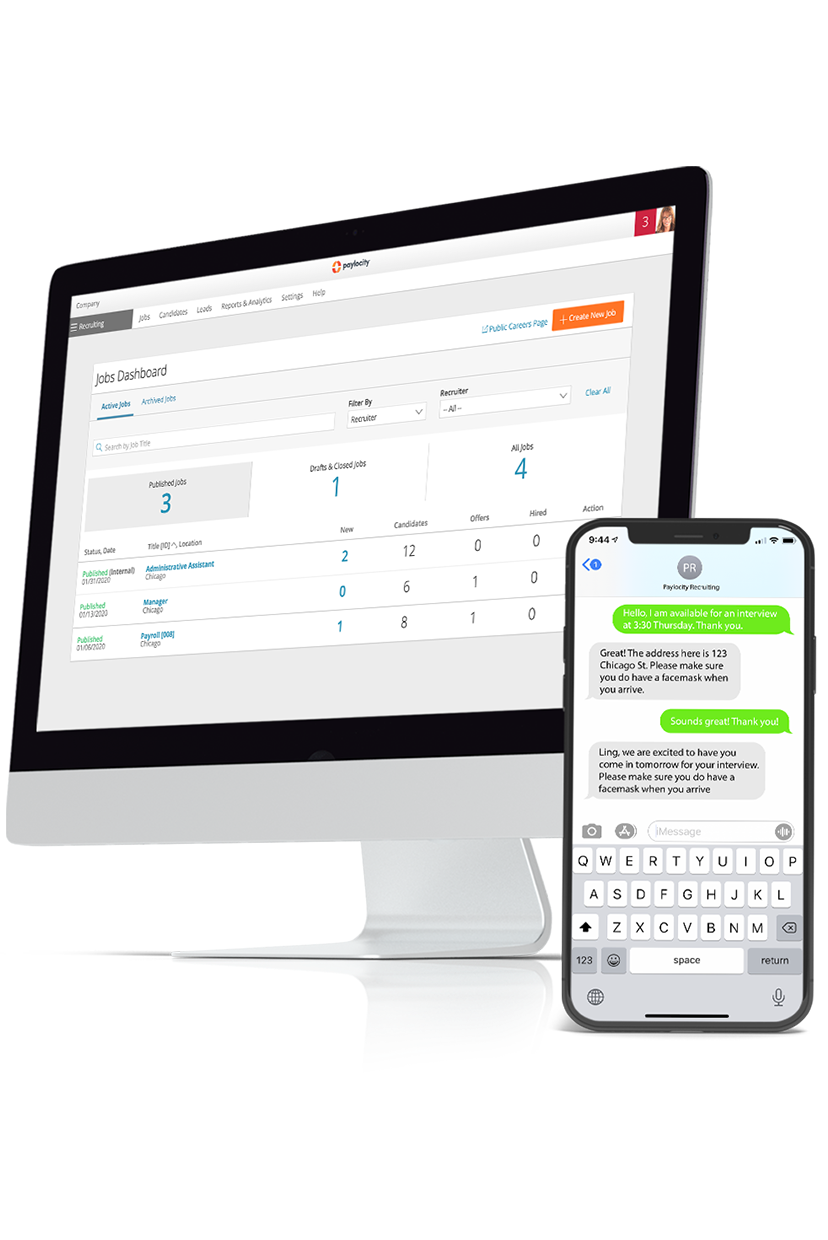
Hire smarter
Finding the right talent for your team can be challenging in today’s market. But with the right tools, it doesn’t have to be a strain on your internal resources as well. Our recruiting platform streamlines the process, bringing you an intuitive way to search for and engage with top candidates. With communication methods like texting and video, and data that helps you track progress, attracting and winning has never been easier.