Permanent establishment (PE)
Summary Definition: A status indicating that a business’s operations in a foreign country subject it to local corporate income taxes.
What is a permanent establishment?
Permanent establishment (PE) is a tax classification that a foreign jurisdiction uses to deem a non-resident company’s local operations liable for corporate income tax.
When a PE exists, it indicates that the business’s local activities are substantial enough to trigger obligations under payroll or tax treaties and laws. Therefore, evaluating permanent establishment risk is an important part of global expansion planning.
Key takeaways
- A permanent establishment arises when a business conducts sufficient activities in a foreign country to incur liability under local tax laws and treaties.
- PE status can be triggered by several factors, such as long-term employees performing core activities or agents authorized to make business decisions on the company’s behalf.
- Auxiliary or preparatory activities, such as market research, advertising, or administrative work, generally are not considered in determining permanent establishment status.
Types of permanent establishment
Permanent establishments can take several forms depending on how and where a business operates in another country:
| PE type | Description | Common examples |
| Fixed Place Permanent Establishment | A stable, physical location in a foreign country where core business activities are conducted. | Office, branch, factory, warehouse |
| Dependent Agent Permanent Establishment | A person or independent agent in a foreign country regularly acting on behalf of the business with the authority to conclude contracts. | Local sales agent who signs or negotiates contracts |
| Service Permanent Establishment | Services performed in another country for an extended period, even without a fixed place of business. | Long-term remote employees or consultants |
| Construction or Project Permanent Establishment | A construction or installation project exceeds treaty-defined time thresholds. | Building sites or infrastructure projects |
| Digital or Virtual Permanent Establishment | A digital presence that generates significant revenue via online tools or services. | Online stores with substantial local activity |
What triggers a permanent establishment status?
PE status frequently results from routine business choices that extend a company’s operations abroad. Nonetheless, certain auxiliary or preparatory activities are typically excluded, as they support general operations but do not create revenue.
| Common PE triggers | Common non-triggers |
| A fixed location for business activities (e.g., procurement) | A fixed location for support activities (e.g., storing goods) or administrative tasks |
| Local workers carrying out revenue-generating or decision-making activities | Local or remote employees performing auxiliary activities (e.g., market research |
| A local entity that legally acts on the company’s behalf (e.g., negotiates contracts) | A local agent performing basic administrative tasks (e.g., answering phones or sorting mail) |
| Construction, installation, or project activities that exceed treaty-defined time thresholds |
What are the consequences of triggering PE status?
Triggering permanent establishment status can create broad tax and compliance responsibilities, including:
- Corporate tax liability: The business may be required to pay local corporate income tax on profits earned from activities in the foreign country.
- Tax reporting: The company may also need to comply with ongoing tax filing and reporting requirements.
- Payroll and withholding obligations: Employing workers in the country may trigger other payroll taxes, social contributions, and employee withholding responsibilities.
- Audit and penalty risk: Failure to identify or manage PE status can lead to tax audits, penalties, interest, and back taxes.
Maximize Productivity the Right Way
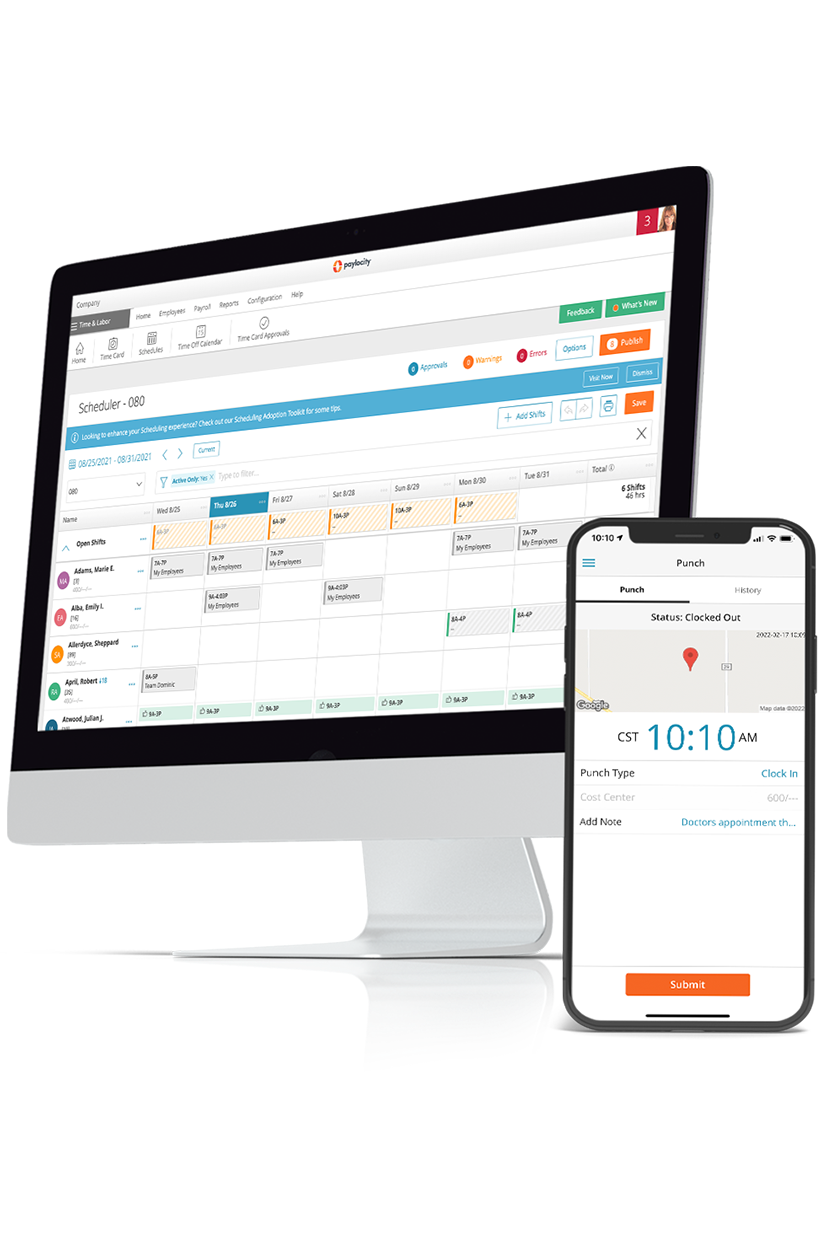
Get out of time-consuming processes while knowing your employees are set up for day-to-day success. The costs — and headaches — of manually scheduling, tracking, and managing your workforce's time adds up fast. Use the right tools to automate where it matters, while delivering a modern, user-friendly experience for employees and their managers.