
Craft the perfect expense policy: Template and examples
Company spending can feel like a complicated puzzle, for both your Finance team and your employees.
Expense confusion is common. A TravelPerk study found 83% of business travelers struggle to reconcile trip expenses, while 24% say they don’t have the time to submit claims. Almost one in five say they don’t even know what’s reimbursable. For the Finance team, that means spending hours explaining policies, chasing receipts, and fixing errors. And those hours add up.
The cost goes even deeper without a clear expense policy and the tools to enforce it:
- Confusing or inconsistent policies mean employees spend valuable time trying to make sense of rules instead of doing their best work.
- The Finance team constantly has to answer the same questions and correct mistakes.
- Reactive work prevents Finance from focusing on more strategic activities that add real value to the business, like financial planning, budgeting, and analysis.
- Constant back-and-forth creates a perception of Finance as a roadblock rather than a strategic partner.
End result: Administrative drag can ultimately stifle the creativity and innovation that drive a business forward.
We all want a workplace that empowers employees to get what they need without bureaucratic headaches and allows the Finance team to focus on strategic insights, not damage control
How can you get there? It starts with a clear, well-structured expense policy and tools that make it easy to enforce.
This short guide offers a step-by-step approach to creating and maintaining an expense policy that works for everyone. We’ll explore how a clear policy can reduce friction, boost morale, and create an environment where innovation thrives.
Once you’ve learned about expense policies, download our template to start creating your own.
What’s an expense policy?
At its core, an expense policy is a formal document that outlines employee spending rules. It defines which costs are and aren’t reimbursable.
A well-crafted policy explains the why and how of company spending. It details the claim submission process, required documentation (like receipts), and reimbursement timelines.
The primary purpose of an expense policy is financial control. It ensures company funds are used responsibly and for legitimate business purposes. Without it, you leave the door open for ambiguity, unintentional overspending, or even fraud. There are strict rules about what constitutes a business expense. An expense policy ensures your company stays on the right side of tax laws, avoiding audits and penalties.
Imagine what would happen if employees always booked first-class flights or expensed a pricey dinner for a client who hasn't signed a contract in years. Without a clear expense policy, anything’s possible.
But with the right one, there are other, less tangible benefits too. A well-crafted expense policy can:
- Empower autonomous decisions: Your team is in control when they have clear guidelines for acceptable spend. A sales manager who knows the meal allowance for client meetings can focus on closing the deal instead of fretting over menu prices.
- Build trust: Transparent rules create a culture of respect. People feel trusted to use company funds responsibly, which makes them more engaged and accountable.
How to create an expense policy: Best practices
Creating an effective expense policy doesn’t have to be complicated. These best practices will help you set clear guidelines:
1. Involve key stakeholders.
Don't create an expense policy in a vacuum. If the Finance team writes a policy without HR input, it might be fiscally sound but operationally impossible.
A smooth collaboration between Finance and HR is essential for success.
Finance brings a deep understanding of fiscal constraints and reporting requirements. Their goal is to ensure that every dollar spent is accounted for and aligns with the company's budget.
HR provides insight into employee experience and what employees need to do their jobs, while ensuring policies are fair and easy to follow.
Together, HR and Finance can strike the right balance between necessary business spending and fiscal responsibility.
A key part of this process is clearly communicating your expense policies across the organization — including specific rules and reasons behind them — to create a culture of collaboration and smart spending. That responsibility typically falls to HR.
2. Keep it simple and accessible.
If your policy requires a law degree to decipher, it won’t help anyone. Instead:
- Avoid jargon: The goal is clarity, not complexity.
- Be specific: Instead of saying "travel reasonably," say "book economy class for flights under 6 hours."
- Make it findable: Don't bury the document in a dusty intranet folder. Make it easily accessible on your employee dashboard or expense management software.
Sharing your expense policy.
Here are some ways to make sure employees can access the policy when needed.
- Store in an easily accessed document library: Paylocity's Document Library is a centralized location where you can upload and store important company documents, organize the library into folders, and grant access to specific employees or groups.
- Company news or announcements: Ensure employees know about the expense policy through a company announcement or news post. This ensures visibility and allows employees to access it easily.
- Employee portal (self-service): Many organizations use the portal in Paylocity to store policies. Upload the expense policy under a section like "Company Policies" or "Resources" for easy access.
- Onboarding or training modules: Add your expense policy to your new-hire checklist or ongoing trainings through the Learning Management System (LMS).
3. Address common categories clearly.
Ambiguity breeds noncompliance. Your policy should explicitly cover the most frequent expense categories:
- Travel: Airfare classes, hotel star ratings, and ridesharing vs. car rentals
- Meals: Per diem limits or actual cost caps for breakfast, lunch, and dinner
- Entertainment: What qualifies as client entertainment? Is alcohol reimbursable?
- Home office: If you have remote workers, be clear about internet stipends or equipment purchases.
4. Set timelines.
State exactly when expenses must be submitted. "Within 30 days of the expense date" is a common and reasonable standard. This prevents the "end-of-year receipt dump" that drives Finance teams crazy and messes up quarterly reporting.
5. Review and update regularly.
The business world changes fast. Inflation drives up meal costs. Travel norms shift. Remote work policies evolve. An expense policy from 2019 likely doesn't account for today's hybrid work environment — or today’s rising restaurant prices. Schedule an annual review to adjust limits and rules to match current economic realities.
HR and finance should work together during this review process.
How can we enforce expense policies without becoming the “expense police?”
Finance teams often walk tightropes. On one side, you have the crucial task of enforcing expense policies to protect the company's bottom line. On the other, you want to work with HR to maintain a positive and innovative culture.
Striking this balance can be tough, and many finance professionals feel like they've unwillingly become "expense police"— constantly chasing receipts and questioning every line item.
The constant back-and-forth over out-of-policy spending is a significant drain on resources. It also slows down reimbursement cycles for employees and pulls Finance teams away from more strategic work.
What if there was a way to enforce expense policies without conflict?
Modern expense management solutions can transform this process. By embedding policy controls directly into the system, you can shift from reactive enforcement to proactive compliance.
Features to look for include:
- Real-time policy flags: A strong expense management platform flags expenses that exceed company limits. This reduces out-of-policy submissions and saves the Finance team from spending time on reviews and rejections.
- Automated approval workflows: Customizable workflows ensure quick approval processing.
- Clear visibility and transparency: A real-time dashboard lets employees track their expense-report status, while managers can view all pending requests. This transparency eliminates follow-ups, builds trust, and provides a complete audit trail for every action. Plus, when employees can track their reimbursement status, they don’t have to repeatedly check with Finance.
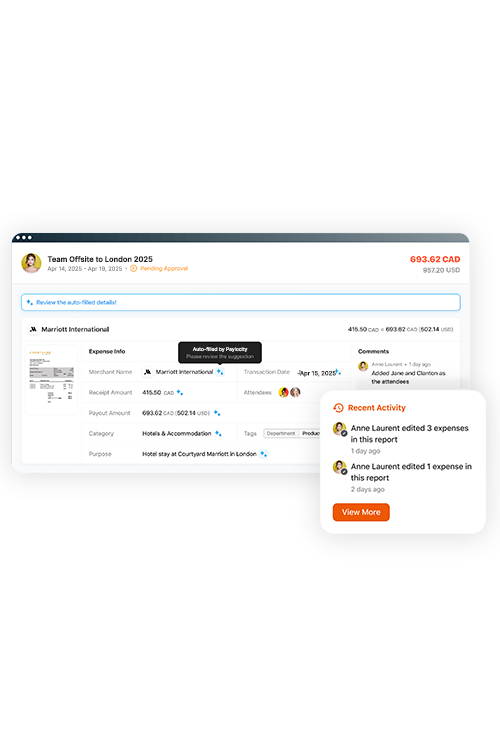
- Simplified receipt management: Employees can capture receipts through a mobile app, which autofills expense details using OCR and ML and automatically attaches to the transaction record. This tech reduces errors, saves time, and ensures all expenses are properly documented.
When CRM startup Affinity started using Paylocity for Finance (then called Airbase), the Finance team noticed a shift right away. “What used to be a post-expenditure questionnaire, ‘Why did you spend this?’, is now a collaborative planning conversation, ‘What will you need to spend on in the short- and the long-term and how will it benefit the business?” - Head of Finance, Affinity.
The surprising link between expense management and innovation
It might seem counterintuitive, but structure can be a catalyst for freedom. When employees don't have to sweat the small stuff, they have more capacity for creative and strategic thinking. A well-defined expense policy removes ambiguity and provides a clear framework for decision-making.
Think of it this way: when the "rules of the game" are clear, players can focus on strategy and skill. An effective expense policy does the same for your employees.
- Reduces cognitive load: Decision fatigue is real. Having a clear policy, automatically enforced, frees up mental bandwidth for complex problem-solving and innovation.
- Empowers employees: Autonomy is a key driver of job satisfaction and engagement. An engineer who can quickly purchase a necessary tool without a lengthy approval process is more likely to stay in a state of deep work and solve problems faster.
- Creates a culture of trust: A transparent policy shows that you trust your employees to be responsible with company money. This trust helps create a positive and collaborative work environment where people feel safe to take calculated risks and propose new ideas.

Related

Unlocking Operational Flow: Efficiency Guide for HR, Finance, and IT
