
The 9 Best Human Capital Management Software Solutions in 2026
As companies grow, so does the importance of implementing strong human capital management (HCM) practices. Without the right platform in place, HR departments and leaders often spend hours caught up in inefficient busywork and time-consuming manual processes split up across disconnected platforms.
HCM has been transformed by the rise of dedicated human capital management software, which unifies HCM procedures into a consolidated platform. The purpose of human capital management software, as a whole, is to help organizations run more efficiently and support their people more effectively. They automate common workflows, help surface actionable insights about people and trends, and make it easier to minimize compliance risk exposure.
In this guide, we’ll break down the best HCM platforms available, going through their key features, use cases, and user reviews so you can find the right fit for your organization.
What is HCM software?
Human capital management software refers to a digital platform that provides the toolset needed to optimize organizational efficiency while nurturing employee growth.
The best HCM software systems typically provide extensive data analytics tools and HR workflow automation capabilities, which allow HR departments to build effective human capital strategies and make informed business decisions at scale.
They combine the capabilities of an HRIS, HRMS, and more to help HR teams execute strategic processes, including, but not limited to:
They combine the capabilities of an HRIS, HRMS, and more to help HR teams execute strategic processes, including, but not limited to:
- Identifying trends across an entire workforce
- Monitoring performance and resource allocation
- Minimizing exposure to regulatory and compliance risks
- Administering payroll and benefits
- Creating a stronger employee experience and culture
- Attracting, developing, and retaining talent
The best HCM software of 2026
Below is a snapshot of the best human capital management software solutions available today. Compare features, pricing, and use cases to identify the best fit for your business.
|
Platform |
Best For | Key Features | Pricing |
|
Paylocity |
All-in-one HCM |
|
Custom |
| Workday HCM | Large enterprises |
|
Custom |
| SAP SuccessFactors | Learning and development |
|
Custom |
|
Oracle Fusion Cloud HCM |
Employee experience management |
|
Plan-based
|
| BambooHR |
Small businesses |
|
Plans start at $10/month/employee
|
| Dayforce | Payroll management |
|
$22-31/employee/month
|
| UKG Pro | Workforce management |
|
$27-37/employee/month |
| ADP Workforce Now | HCM data benchmarking |
|
Custom |
| Deel | Global organizations |
|
Plan-based |
1. Paylocity
?ts=1769814540197&$ProductTIleImage$&dpr=off)
Best for: All-in-one HCM
Paylocity is a leading human capital management solution designed to help businesses build and support a talented workforce, create a culture that employees love, and reinforce organizational efficiency.
With AI features that speed up processes, surface critical data insights, and provide proactive assistance, Paylocity lets organizations implement HCM at scale, vetting every decision with a clearer idea of how it will impact productivity, profitability, engagement, culture, growth, and overall organizational health.
The platform offers solutions for core HCM functions, including HR, payroll and expense management, time and labor management, and talent management. In addition, it includes employee experience tools designed for culture-building, an employee self-service portal that maximizes convenience, and extensive workflow automation capabilities.
Key features:
- AI embedded across the platform: With automation triggers that automate everyday tasks, AI-powered analytics that surface key information quickly, and intelligent assistive capabilities for both leaders and employees, Paylocity’s AI capabilities make world-class human capital management achievable at any scale.
- Workforce analytics and reports: The platform is built around comprehensive dashboards and automated reports that allow organizations to track critical data, such as compliance risks, labor costs, employee retention, and more. They come embedded with AI assistance, allowing teams to quickly identify, monitor, and respond to trends and issues effectively at scale.
- Payroll administration: Paylocity provides a complete payroll management solution, featuring customizable reporting, built-in auditing and error resolution tools, guided tax rule compliance, and more. It gives teams total visibility into labor costs and potential risks, all in one connected space.
- Talent management: Paylocity allows teams to leverage automations across the recruitment, onboarding, and employee development processes, freeing up hours of time that can be spent focusing on the employee instead of completing tedious, manual work. It also includes an integrated learning management system for simplified training deployment and a tool for benchmarking compensation plans against competitors.
- Employee experience management: Businesses can use Paylocity to deploy feedback surveys, encourage peer-to-peer recognition, and foster a thriving internal community with social features, each of which contributes to building or strengthening an engaging culture that boosts retention.
- Time and labor management: Paylocity features data-driven solutions for time and attendance management, scheduling, and time collection. Teams can leverage real-time insights to enforce compliance, conduct speedy time card reviews and approvals, build optimized schedules, and more, all within the same platform.
Pricing: Custom
?ts=1767882597017&$ProductTIleImage$&dpr=off)
2. Workday HCM

Best for: Large enterprise HCM
Workday is a human capital management platform powered by Workday Illuminate™, the platform’s AI assistant. It combines core HR, workforce planning and analytics, talent management, and employee experience management tools, aiming to help teams handle the complexity and scale of enterprise HCM.
This HCM system’s extensive automation capabilities, in-depth analytics, and capacity to integrate with hundreds of different apps and APIs make it suitable for HR teams managing massive workforces. It’s powerful and built to handle complexity, which is ideal for very large organizations; however, users who just need quick deployment and simple features may find it burdensome.
Users praise the platform for its comprehensive, enterprise-friendly feature set, but are divided on the UI experience. Some also point out that the platform has a steep, technically intensive learning curve, and that it can run slowly at times.G2 - Workday HCM Review
Key features:
- Workday Skills Cloud: Workday Skills Cloud gives leaders and HR teams visibility on skills and competencies across their entire organization. With AI-powered insights, teams can identify skill deficits, plan and deploy skills training, and track progress.
- Workday Prism Analytics: Workday Prism Analytics helps organizations identify their top HR priorities with comprehensive data on employee sentiment, workforce activity, and the overall talent pipeline. Teams can also benchmark their internal data against anonymized insights from thousands of employers for industry-wide visibility.
- Global compliance: For multinational organizations, staying on top of regulatory changes across the globe is often time-consuming, costly, and error-prone. Workday’s experts also keep teams updated on all relevant legal changes, eliminating the need for manual research.
Pricing: CustomWorkday - Adaptive Planning
3. SAP SuccessFactors

Best for: Learning and development
SAP SuccessFactors is another enterprise-focused HCM solution. It positions itself as a platform for global HR management, with a foundation in automation to help streamline and improve HR operations throughout the employee lifecycle.
The platform is designed to help HR staff operating in a single region manage a workforce that spans across the world. Teams can configure SuccessFactors’ UI and language, payroll and compliance automations, and benefits administration automations based on where their team is operating.
Users appreciate the platform’s integration features and user experience. However, some find it to be overly complex and say that its customizability limitations make it challenging to integrate specific workflows.G2 - SAP SuccessFactors Review
Key features:
- Talent Intelligence Hub: The Talent Intelligence Hub lets HR teams define the specific attributes (such as skills, strengths, and communication preferences) they want to see in their organization and help employees develop the ones they need with Growth Portfolio.
- Opportunity Marketplace: SAP’s Opportunity Marketplace uses AI and machine learning to connect employees with growth opportunities. This could include learning programs, mentoring programs, or even new role applications.
- Sales performance management: SAP SuccessFactors gives leaders unique visibility into sales team performance metrics. Teams can also build trust and motivation in their sales departments with incentive compensation and a sales-specific employee experience management tool.
Pricing: CustomSAP SuccessFactors Pricing
4. Oracle Fusion Cloud

Best for: Employee experience management
Oracle Fusion Cloud is a cloud-based human capital management software developed as a part of the Oracle Fusion Cloud ecosystem. It features a data-driven employee engagement platform and talent management tools, as well as a comprehensive set of workforce management features, and more.
Reviewers appreciate the platform’s AI integration, talent acquisition tools, and user-friendly experience. However, some note that deploying Oracle Fusion Cloud is often a long and complex process. Users also point out that it lacks some important third-party integrations and general customizability options.Gartner - Oracle Fusion Cloud HCM Reviews
Key features:
- Oracle ME: For HR staff and people leaders, Oracle ME provides a searchable workforce directory, a platform to deliver targeted communications, and data-backed solutions for managing employee sentiment and developing skills throughout the organization. Meanwhile, employees can build organic connections with their peers, recognize their colleagues for a job well done, and submit tickets through an HR Help Desk.
- Talent management tools: Oracle merges recruiting, onboarding, training/development, performance management, compensation, succession planning, and skill-building into one solution.
- Workforce management tools: Oracle’s workforce management solution helps HR teams optimize labor allocation, scheduling, and compliance while efficiently tracking time, processing leave requests, and reducing accidents and safety hazards.
Pricing: Plan-basedOracle Fusion Cloud Global Price List
5. BambooHR

Best for: Small businesses
If you need a rapidly deployable, easy-to-use HR platform, BambooHR is a solid option. While it lacks the hyper-complexity and global scalability of a dedicated enterprise HCM system, BambooHR can adequately handle core HCM functions for small businesses.
Powered by an AI assistant, this platform lets leaders and HR staff manage employee experience and performance, payroll and benefits, hiring and onboarding, and compensation planning all in one place.
BambooHR is held in high regard for its ease of use and customer service experience, but users note that it has limited features and difficulty adapting more complex HR workflows.G2 - BambooHR Review
Key features:
- Integrated applicant tracking system: BambooHR comes with an integrated ATS that lets HR teams and business leaders source talent across job boards, automate and personalize communications (from update emails to job offers), and track talent pipeline analytics.
- Employee experience management tools: BambooHR provides a central platform for employee experience management, merging tools for communication, recognition, and data-backed employee sentiment analysis.
- Compensation benchmarking: For small businesses, keeping compensation packages on par with peers and larger competitors is critical for talent retention. BambooHR lets you do just that by benchmarking your compensation metrics against trustworthy data from other employers in your industry.
Pricing: Plans start at $10/month/employeeBambooHR - Pricing
6. Dayforce

Best for: Payroll management
Dayforce is an HCM platform targeted towards a range of medium-sized businesses to very large enterprises across multiple industries.
It unifies core HCM use cases (like payroll administration, talent management, and employee experience management) in an AI-embedded platform that offers unique solutions for on-demand payment and contractor/freelancer management.
Reviewers praise its rich feature set targeted towards those with complex workforce management needs. However, they also note that Dayforce doesn’t always integrate well with existing systems, meaning that full-scale implementation may require process adjustments.Outsail - Dayforce Review
Key features:
- Dayforce Payroll: Dayforce Payroll simplifies and automates payroll administration and compliance risk detection for over 200 different countries and territories, reducing the administrative burden for HR teams in organizations operating at a global scale.
- Dayforce Wallet: Dayforce Wallet is an added extension of Dayforce Payroll. It lets HR teams provide employees with access to on-demand and off-cycle payments, a critical step towards retention in hourly positions.
- Dayforce Flex Work: Dayforce Flex Work lets HR teams seamlessly manage contractors, freelancers, and other flexible talent. It provides a consolidated vendor management platform, real-time analytics (including compliance, spend, and more), and scheduling automation that dynamically applies pay rates and vendor rules.
Pricing: $22-31/employee/monthOutsail - Dayforce Pricing
7. UKG Pro

Best for: Workforce management
UKG Pro is a human capital management software solution that’s useful for businesses operating in highly structured industries that rely on large, hourly workforces (such as retail, manufacturing, and healthcare).
It lets teams manage scheduling, payroll, employee engagement, and talent management, with AI-driven insights for culture-buildingUKG - Great Place To Work Huband reporting tools that help maintain compliance with important regulatory considerations (such as meal and break regulations).
Users appreciate UKG Pro for its comprehensive feature set and integration capabilities, but some note limitations, such as a difficult user interfaceG2 - UKG Review (which may be partially corrected with their recently released AI-guided UXUKG - UKG Debuts New AI Guided User Experience).
Key features:
- Bryte AI™: Bryte AI lets HR teams use a conversational chat interface to surface insights from employee data to support strategic initiatives like culture building, compensation equity, and leadership training.
- Forecasting and scheduling tools: UKG Pro Forecasting uses machine learning to provide actionable recommendations for optimized scheduling, giving leaders and HR staff a solid baseline that they can modify based on in-the-moment needs.
- Workforce analytics: UKG provides a central analytics dashboard with an AI that provides proactive recommendations to improve employee engagement and mitigate burnout, attrition, and turnover.
Pricing: $27-37/employee/monthOutsail - UKG Pricing
8. ADP Workforce Now

Best for: HCM data benchmarking
ADP Workforce Now is an HCM platform that automates compliance, reporting, and case resolution. With AI-driven intelligence and a unified data benchmarking platform, ADP Workforce Now helps HR teams streamline workflows and drive strategic initiatives.
The platform comes with a vast library of industry-specific HR app integrations, making it an ideal choice for growing companies in highly regulated industries who need a platform that conforms to their workflows, not the other way around.
Users praise that platform’s ease of use, efficiency, and comprehensive feature set, especially its self-service portal. However, some users point to a steep learning curve that makes it difficult to access and utilize the platform's more advanced features.Forbes - ADP Workforce Now Review
Key features:
- ADP DataCloud: ADP DataCloud is a data repository that combines workforce insights from over a million anonymous employers, letting HR teams benchmark their employee data against industry-relevant competitors to inform strategic decisions.
- ADP MarketPlace: ADP MarketPlace offers hundreds of HR-oriented apps and integrations for Workforce Now, covering numerous industries and use cases. This helps you customize your HCM platform to meet your specific needs.
- Talent management tools: ADP Workforce Now’s talent management tools include a recruiting and hiring platform, an employee training solution with thousands of pre-built course paths, an engagement and performance management platform, and more.
Pricing: CustomOptions and Pricing for ADP Workforce Now
9. Deel

Best for: Global organizations
For companies with employees and subdivisions across multiple countries, human capital management becomes much more difficult. Teams must reconcile with vastly different regulatory considerations, payroll requirements, and logistical hurdles.
Deel positions itself as the tool to remedy these challenges and more, providing global HR, payroll, and IT management solutions. This combination makes it a strong fit for remote and hybrid companies hiring talent and contractors in multiple countries.
Reviewers mention that Deel is very easy to use, simplifying complex global payment and onboarding processes. Others point out its advanced compliance tracking capabilities and localized benefits packages. With that said, the platform is said to be costly, with high transfer fees and occasional errors that introduce delays.Rivermate - Deel Pricing
Key features:
- Global payroll and compliance management: Deel Payroll, the platform’s global payroll management suite, helps organizations hire and pay employees and contractors in over 150 countries. It executes automatic tax calculations, automates contract creation, provides payment options in over 200 currencies, handles complex international regulatory requirements, and more, all with AI-powered risk identification and suggestions.
- Workforce planning tool: Deel consolidates HR, finance, and recruiting data into one platform, removing the need to keep multiple disconnected spreadsheets and systems up to date. And with scenario modeling and forecasting features, real-time collaboration tools, automatic approvals, and AI-driven insights, teams can mobilize their data to create optimized headcount plans and set their company up for success.
- Global mobility and logistics: Global companies need high mobility, with the capability to support and relocate staff across borders as needed. Deel simplifies complex visa and immigration procedures and helps teams remain compliant throughout the process. Deel can also facilitate logistical processes in over 130 countries, including equipment delivery, management, and recovery.
Pricing: Plan-basedDeel - Pricing
Key features of HCM platforms
When evaluating options for HCM platforms, consult directly with all relevant stakeholders to identify issues and potential areas for improvement in your processes.
While the answers you receive will vary greatly depending on your specific needs, there are several critical features you’ll want to keep in mind as you browse the market and build your shortlist.
- AI capabilities: AI features help HR teams automate time-consuming administrative work, surface critical workforce insights across massive datasets, and get quick answers to complex questions without needing manual input. Examples of HCM AI features could include conversational and agentic chatbots, workflow automation triggers, and automated reporting capabilities.
- Benefits administration: With a benefits administration platform, teams can use HCM systems to simplify processes, such as benefits enrollment, management, and tracking. HR teams gain valuable insights into benefits utilization and costs, while employees can choose and manage their own benefits.
- Compliance management: Look for HCM platforms that supports compliance management. Features like proactive risk alerts, automated tax filing, and routine regulatory updates help HR teams keep up with constantly changing payroll, tax, and labor policies, saving countless hours at scale.
- Data security features: As HCM platforms handle sensitive company and employee data, you’ll want to prioritize those with airtight security. Look for platforms that maintain compliance with data security standards (including ISO 27001, SOC 1, and SOC 2) and feature critical security levers like identity and access management options, audit logs, and session monitoring.
- Employee experience management: For effective human capital management, HR teams must regularly capture, analyze, and act on feedback to improve the employee experience. Look for HCM platforms that offer survey tools and analytics dashboards to reveal high-level trends and insights across your organization (such as sentiment, satisfaction, and turnover). For the day-to-day, you might also consider systems that enable employee recognition and socialization.
- Payroll management: Consistently making accurate and timely payments is critical for maintaining employee trust and ensuring regulatory compliance. When evaluating HCM platforms, look for critical payroll management features that ease the burden on your HR team, like direct deposit compatibility, general ledger mapping, and automation features for payment, compliance, and error reporting.
- Talent management: HR teams need platforms that centralize and simplify the process of recruiting, developing, and retaining employees. Seek out human capital management software solutions with capabilities that make the process easier, like automated onboarding tools, integrated learning management systems, and employee feedback platforms.
- Workforce management: Optimizing productivity, efficiency, and performance while minimizing exposure to regulatory risks is a fundamental part of human capital management. Prioritize HCM software that offers key workforce management capabilities, such as scheduling, labor allocation, forecasting, time and attendance, and workforce analytics.
- Integration capabilities: Businesses often have HCM processes scattered across various third-party applications and internal platforms. HCM platforms that integrate seamlessly with existing systems are typically easier to deploy, allowing HR departments to keep their processes largely intact.
Upgrade your HCM and unify cross-functional teams with Paylocity
Human capital management software allows teams to streamline HCM workflows, make more impactful business decisions, and reduce risks and costs at scale, helping leaders and HR teams make a tangible impact on their organization and the people within it.
Paylocity combines HR, Finance, IT management, and more into a single unified platform with extensive AI capabilities that make HCM a strategic, high-ROI process.

Request a Demo to see exactly how Paylocity can level up your HCM capabilities.
Human capital management software FAQ
How does HCM software differ from HRIS and HRMS systems?
HCM software solutions typically enable a more comprehensive, strategic approach to managing people across the entire employee lifecycle by combining the capabilities of a human resource information system (HRIS) and a human resource management system (HRMS).
How long does it take to implement an HCM platform?
Implementation timelines depend on the scale of your company and platform of choice. Integrating an HCM platform in a new small-to-medium-sized business can be completed in just weeks.
However, achieving full integration in a large-scale or enterprise environment often requires several months of concentrated effort due to the greater scale, complexity, and volume of existing processes and systems.
What is the ROI of implementing HCM software?
A strong ROI from an HCM platform is achieved when it results in tangible benefits for your HR department, helping them better support your organization and its people.
To calculate a quantifiable ROI, track critical KPIs, including, but not limited to, time savings, cost and error reductions, and improvements in employee retention. Then, analyze and interpret the value of those metrics against the total investment cost of the platform.
Sources
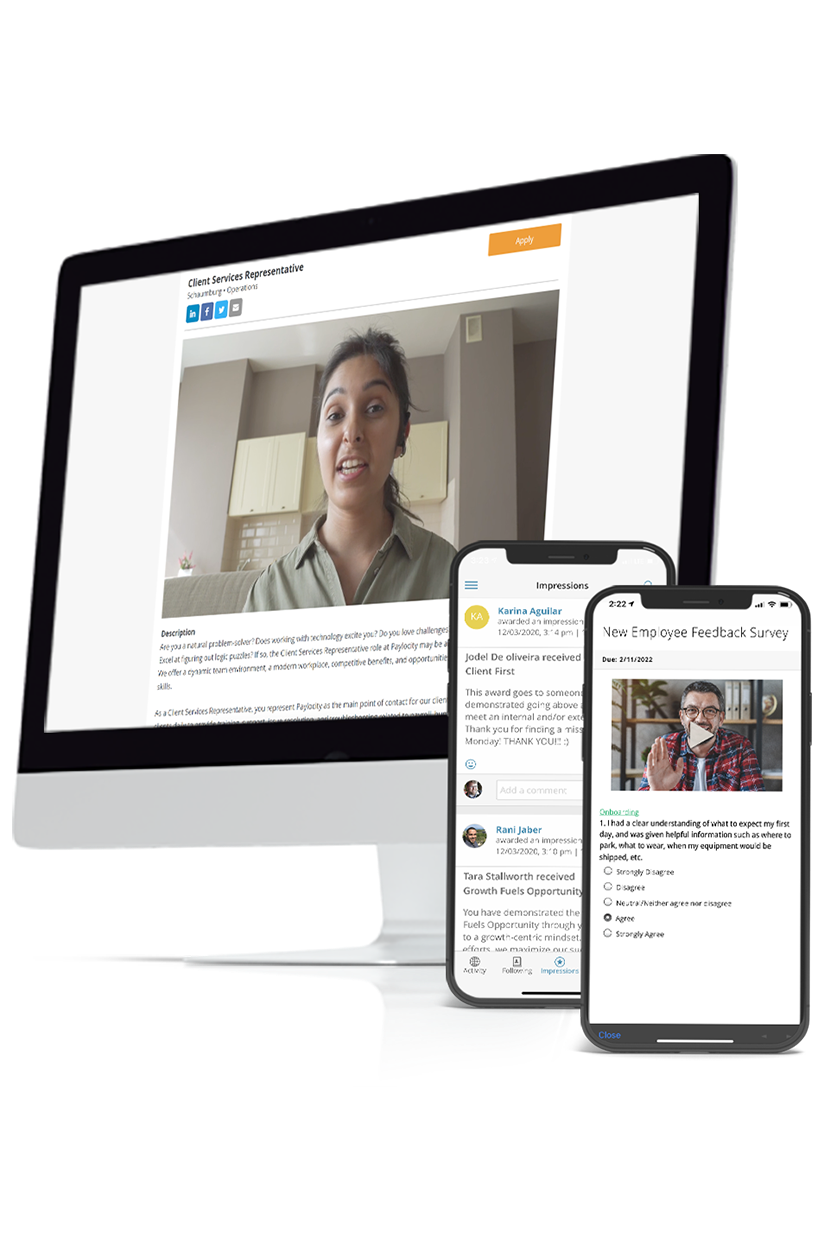
Engage, Empower, and Elevate Your Workforce
Drive meaningful communication, collaboration, and connection across your organization with our all-in-one employee experience platform. Designed to be more than just an HR tool, it’s a platform your employees will use daily to engage with their work, their peers, and your company’s culture.

![10 Best Payroll Software for Nonprofit Organizations [2026]](https://s7d9.scene7.com/is/image/paylocity/best-payroll-software-for-nonprofit-organizations-hero?$Hero-Card$)