Endpoint security
Summary definition: A cybersecurity approach that protects end-user devices from threats that use them as an entry point into an organization's network.
What is endpoint security?
Endpoint security, also called endpoint protection, is the practice of securing every device that connects to a corporate network against unauthorized access, malware, data theft, and other cyber threats.
The importance of endpoint security has grown in recent years as remote work and cloud adoption have multiplied the number of devices connecting to corporate infrastructure. Each device can serve as a potential entry point for attackers seeking to target sensitive data or gain broader network access.
Key takeaways
- Endpoint security is a cybersecurity effort for protecting devices connecting to a corporate network from various cyberattacks.
- Modern endpoint protection cybersecurity stacks multiple layers to block known threats, detect and respond to breaches, and correlate device activity across the full digital environment.
- Effective network endpoint security requires several best practices, such as maintaining a complete device inventory, enforcing patch management, and training employees on endpoint risks.
What is an endpoint?
In cybersecurity, an endpoint is any device that communicates with a corporate network, whether on-premises or over the internet. Common endpoints fall into one of three groups:
| Category | Examples | Primary risk |
| User devices | Laptops, desktops, tablets, smartphones | Phishing, credential theft, malware |
| Infrastructure devices | Servers, virtual machines, cloud workloads | Ransomware, unauthorized access, data exfiltration |
| Operational devices | Internet of Things (IoT) devices, printers, point-of-sale terminals | Limited visibility, unpatched firmware, lateral network entry |
How endpoint security works
Modern endpoint security solutions are a layered stack of capabilities, each addressing a distinct phase of the attack lifecycle:
- Endpoint Protection Platform (EPP): The preventive layer that uses antivirus, firewall controls, application whitelisting, and AI-powered static analysis to block known threats before they infect a device. While potent, it can struggle with sophisticated or novel attacks that evade signature-based detection.
- Endpoint Detection and Response (EDR): The threat detection and response layer that continuously monitors device activity using behavioral analytics and machine learning to identify threats that EPP tools may miss (e.g., zero-day exploits or fileless attacks). When a threat is identified, EDR can automatically quarantine endpoint devices, kill malicious activities, and generate a forensic timeline for investigation.
- Extended Detection and Response (XDR): The correlation layer that extends detection and response beyond individual devices by correlating telemetry across endpoints, networks, cloud environments, and identity systems. Where EDR shows what happened on a single device, XDR shows the full attack chain across the organization's digital infrastructure.
Common endpoint security threats
Attackers target endpoints because they’re the most direct path to sensitive information and network access. While not a complete list, the majority of endpoint protection solution incidents organizations face include:
| Threat | How it works |
| Malware | Malicious software installed on a device to damage, disrupt, or gain access |
| Ransomware | Encrypts files or systems and demands payment for the decryption key |
| Phishing | Fraudulent messages that trick users into revealing credentials or executing malicious files |
| Zero-day exploits | Attacks that target previously unknown vulnerabilities or gaps in operating systems and applications |
| Insider threats | Malicious or negligent actions by employees or contractors with legitimate device access |
Endpoint protection best practices
Deploying an endpoint security solution is necessary but insufficient on its own. Additional best practices, such as the following, further address the gaps that most commonly leave organizations exposed:
- Maintain a complete device inventory: IT teams can’t protect devices they don’t know exist, including employee-owned hardware used for work (e.g., personal smartphones).
- Enforce patch management: Most successful network endpoint attacks exploit known vulnerabilities for which patches exist but haven’t been installed yet. Applying operating system and application updates promptly closes that window before attackers can use it.
- Apply least-privilege access: Restricting device and user permissions (e.g., role-based access control (RBAC) or privileged access management (PAM)) limits the blast radius of a compromise. Thus, a breached endpoint should provide access only to what that user legitimately needs, not a path across the network.
- Integrate EDR with security operations: Endpoint security protection is only effective when someone responds to it. Connect endpoint security software alerts to an internal or managed security service so detections translate into containment.
- Train employees on endpoint risks: Phishing succeeds by targeting the person at the keyboard, not the technology. Regular training on recognizing sophisticated threats reduces the frequency with which end-user behavior bypasses endpoint security services.
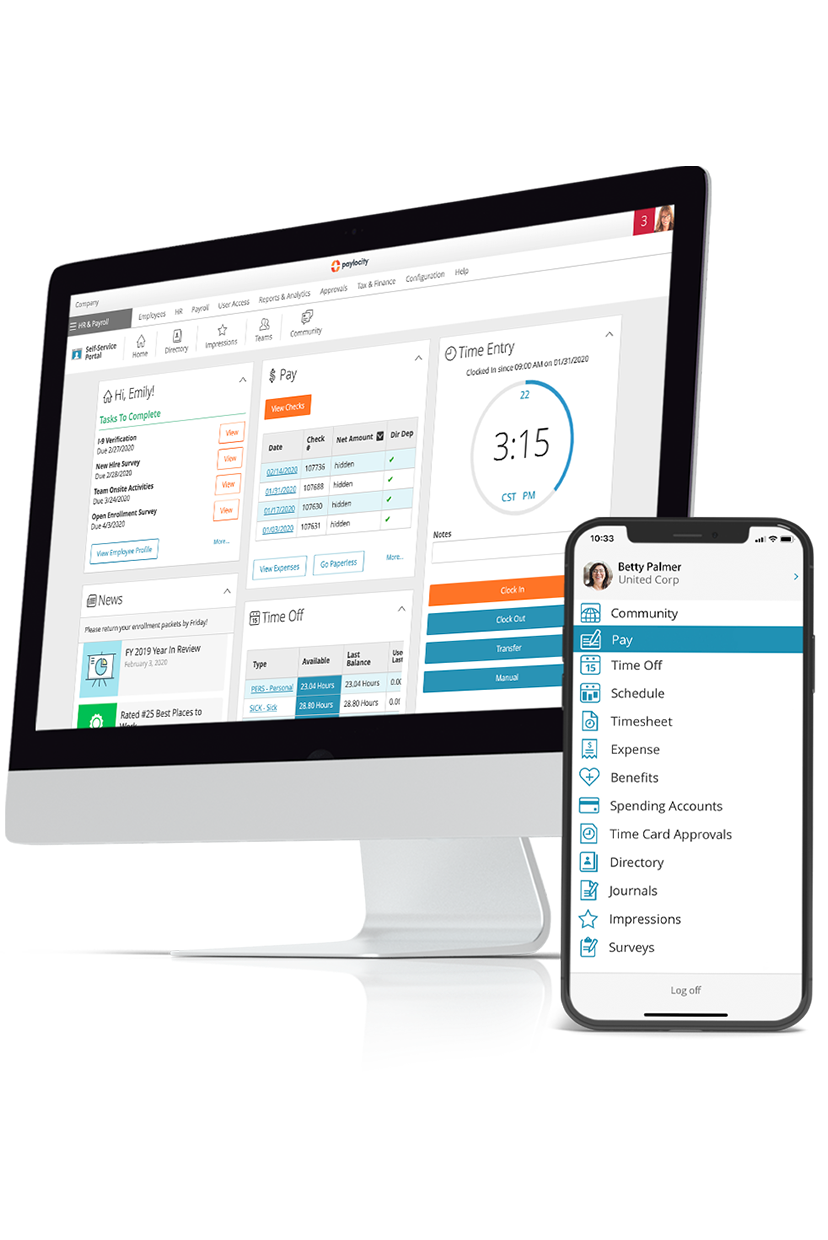
Put the power in their hands
Give your employees the power to do it on their own with Employee Self Service (ESS). With secure, 24/7 access to their information, ESS gives employees one convenient place to view checks, request time off, print tax documents, clock in and out, and connect with their peers. And it’s quick and easy for supervisors to approve requests and view scheduling, putting more time back in your day to work on other initiatives.