Job enrichment
Summary definition: A job design strategy that adds depth, responsibility, and autonomy to a role.
What is job enrichment?
Job enrichment is an employee engagement strategy that increases the depth, responsibility, and autonomy of a role, making work more meaningful, challenging, and self-directed for the worker.
Rather than simply adding more tasks, job enrichment focuses on restructuring an employee's job to address higher-order psychological needs (e.g., achievement, recognition, and personal growth).
Key takeaways
- Job enrichment is an employee engagement strategy that restructures roles to increase autonomy, ownership, and challenge, addressing higher-order psychological needs such as achievement, responsibility, and growth.
- While they both affect the employee experience, there are significant differences between job enrichment vs. job enlargement, such as direction of change and potential risks.
- Effective job enrichment involves specific dimensions of role depth, such as delegating decision-making, building in direct feedback, and allowing stakeholder contact, rather than simply increasing task volume.
What is job enrichment vs. job enlargement?
To fully explain job enrichment, it’s helpful to compare it to job enlargement. While the two concepts share a similar name, the primary difference between job enlargement and job enrichment is that enrichment adds depth, autonomy, and responsibility to a role, whereas enlargement merely increases the number of tasks at the same level.
Thus, enlargement can be a form of enrichment, but only if the additional tasks also add depth to the employee’s activities. Otherwise, choosing between job enrichment vs. enlargement will produce very different outcomes for employee engagement.
| Trait | Job enrichment | Job enlargement |
| Direction of change | Vertical (adds depth, authority, and complexity) | Horizontal (adds more tasks at the same level) |
| What changes |
|
Volume of equally challenging tasks |
| Effect on motivation | Drives intrinsic engagement | Increases task quantity |
| Risk |
|
Can cause job creep (i.e., unmanageable task load without added meaning) |
Job enrichment strategies
Job enrichment strategies target specific role dimensions and depth by restructuring how work is assigned and performed, including:
- Delegating decision-making authority: Transfer decisions that would ordinarily sit with a manager to the employee performing the work.
- Providing direct feedback: Build feedback into the role itself so employees can assess their own performance without depending entirely on manager review.
- Adding client or stakeholder contact: Give employees direct exposure to the people affected by their work rather than routing all external interaction through a manager.
- Creating peer leadership opportunities: Assign employees responsibility for mentoring, onboarding, or leading a small initiative without a formal title change.
- Increasing task identity: Give employees visibility into how their individual contributions connect to a larger outcome through project transparency, team briefings, or direct reporting on impact.
Job enrichment benefits
When implemented effectively, job enrichment addresses the intrinsic quality of work rather than the conditions surrounding it. This, in turn, produces outcomes that are difficult to achieve through compensation or benefits changes, such as:
- Higher employee engagement: Employees given greater autonomy and challenging tasks feel a greater sense of ownership, boosting their commitment to their work.
- Improved performance and quality: Motivated employees who control their work, from execution through decision-making, tend to produce higher-quality work than those following narrow, prescribed tasks.
- Deeper skill set development: Enriched roles expose employees to higher-level responsibilities, accelerating their ability to learn new skills and take on broader contributions while building the internal talent pipeline without external hiring.
- Reduced turnover rate: Employees who find their roles stimulating and see a path for growth are more likely to experience increased job satisfaction, making them less likely to leave.
- Stronger work environment: Roles designed around skill variety, autonomy, and feedback foster a culture where employees feel valued and invested, reinforcing team cohesion.
What are some examples of job enrichment?
A standard job enrichment definition or example varies to suit the role’s function. However, the consistent underlying trait is that each role is redesigned to give the employee greater ownership and autonomy over their assignments.
| Role | Pre-enrichment | Post-enrichment |
| Customer service rep | Follows a script and escalates all complaints to a supervisor | Allowed to resolve complaints and owns the customer relationship end-to-end |
| Sales associate | Executes assigned outreach sequences set by a manager | Leads client onboarding sessions and designs their own territory strategy |
| HR coordinator | Processes onboarding paperwork and schedules orientations | Designs onboarding program, collects feedback, and presents suggestions to leadership |
| Software developer | Implements features specified by a product manager | Owns feature design from scoping through deployment |
| Warehouse associate | Follows a fixed pick-and-pack process defined by operations management | Identifies workflow inefficiencies and contributes to process redesign |
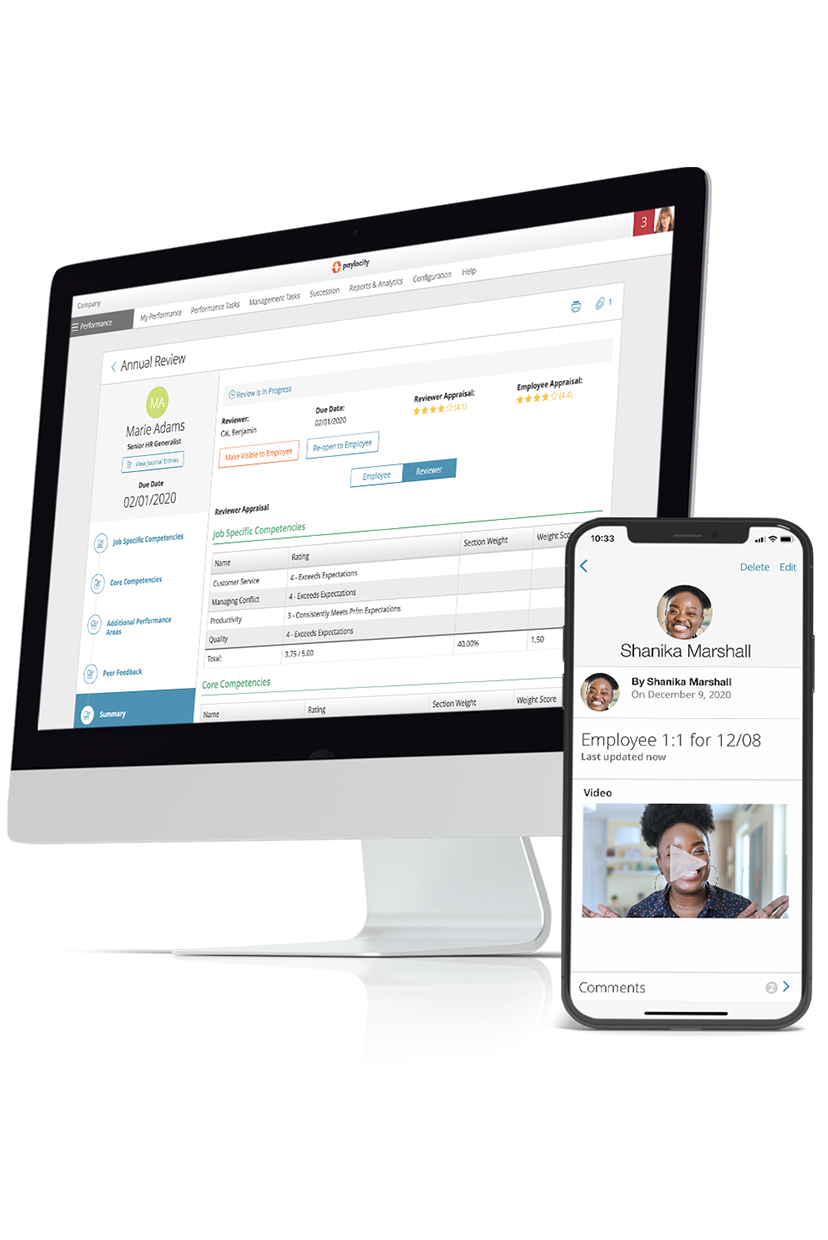
Level up employee performance
Help your employees reach their full potential with modern performance management tools. From goal setting to personalized reviews and ongoing feedback, our solutions enable transparent, two-way communication and encourage employees to take ownership of their growth. Employees expect continuous development and support — give it to them with Performance Management from Paylocity.