
What is Candidate Ghosting? (And How to Avoid It)

Candidate ghosting isn’t a rare recruiting problem anymore. It’s a common part of hiring, especially in tight labor markets and high-volume roles. A candidate applies, responds to a few messages, maybe even schedules an interview or accepts an offer, and then disappears.
For HR professionals, that silence creates real problems. It slows hiring, adds manual follow-up work, raises recruiting costs, and puts pressure on teams. It can also hurt the candidate experience across your pipeline when recruiters are distracted chasing unresponsive applicants instead of focusing on moving qualified people forward.
Fortunately, most cases of candidate ghosting aren’t random. Usually, it comes back to a few clear issues in the hiring process, meaning that with the right tools and insights, you can keep candidates engaged and improve hiring outcomes.
Key Takeaways
- Candidate ghosting occurs when job seekers abruptly stop responding during the hiring process.
- This disruption not only delays staffing goals and increases hiring costs, but it also forces HR teams to focus on administrative tasks rather than strategic initiatives.
- Ghosting often stems from slow communication, process friction, and a lack of personal connection, but it can be mitigated through best practices and integrated technologies that improve recruiting speed, clarity, and empathy.
What is candidate ghosting?
Candidate ghosting happens when a job seeker stops responding during the hiring process without explanation. It can happen at almost any stage, from their initial application up to even day one.
That’s what makes candidate ghosting so frustrating. It doesn’t just affect the top of the funnel. It can disrupt the whole hiring process and lead to:
- Longer time to hire
- Higher recruiting costs
- Lower recruiter productivity
- Missed staffing goals
- More stress for talent management teams
Why is candidate ghosting a red flag?
When candidates disappear, HR and talent management teams have to spend time rescheduling interviews, reopening roles, rebuilding momentum, and chasing updates.
As a result, open positions stay open longer, productivity suffers, hiring managers lose confidence in the process, and HR teams spend more time on administrative tasks than strategic work.
Bottom line, if you want to streamline your HR operations, reducing candidate ghosting is part of the job.
Common candidate ghosting reasons
Candidate ghosting rarely happens in a vacuum. More often than not, it’s the result of one or a few issues with an organization’s own recruiting process.
| Cause | Explanation |
|---|---|
| Slow communications | Arguably the biggest reason for candidate ghosting is that employers take too long to respond. Candidates typically consider multiple opportunities at the same time, so if your team waits a few days to follow up, someone else may already have their attention. |
| Process friction | Pipeline friction can come from many sources (e.g., long application forms, unclear instructions, too many interviews, etc.) and cause candidates to choose the path of least resistance. If your process feels repetitive, confusing, or never-ending, they may walk away entirely. |
| Lack of human connection | Candidates are more likely to stay engaged when they feel like they’re talking to real people. If every touchpoint and follow-up feels generic, cold, or automated, your company becomes easy to forget. |
| Better offers | Sometimes candidate ghosting occurs because another employer offers higher wages, better benefits, or a more flexible work environment. In such cases, speed and transparency are critical if you want to remain competitive for high quality talent. |
| Life events | Not every case of candidate ghosting is intentional. Illness, family issues, transportation problems, and personal stress can all interrupt the process. Some candidates may feel embarrassed if they miss a step or forget an appointment, so they stop responding altogether. |
Why has candidate ghosting become more common?
Applying for a job is easier than ever, and job seekers often enter multiple hiring processes simultaneously.
That means today’s employers more frequently compete on speed, clarity, convenience, and experience than on their brand or reputation. Thus, when a hiring process feels slow, confusing, or impersonal, candidates move on.
In other words, candidate ghosting is often less about candidate behavior and more about whether your process gives people a reason to stay engaged.

How to mitigate candidate ghosting
While you may not be able to eliminate candidate ghosting entirely, you can significantly minimize it. To that end, the best approaches combine speed, clarity, empathy, and the right technology.
Best practices to reduce candidate ghosting
Because candidate ghosting is so commonly connected to process issues, the easiest and most impactful ways to reduce it require adopting new best practices, such as:
| Best Practice | Explanation |
|---|---|
| Moving faster |
Speed is one of the most effective ways to reduce ghosting. Review your hiring process and ask questions like the following to find stages where candidates wait too long.
|
| Clarifying communications |
Clear communication helps reduce confusion, one of the biggest reasons candidates ghost. Candidates, for instance, should always know:
|
| Following up with empathy | As frustrating as it can be for candidates to go quiet, automated messages rarely bring them back. Instead, a short, kind note that gives them a simple next step is often the better option. |
| Giving candidates a graceful exit | Sometimes silence is easier than saying no. As such, giving candidates a respectful way to opt out can often provide the confirmation that ghosting obscures. Letting them know, for example, that if they don’t respond by a certain date, you’ll assume they’re no longer interested keeps expectations clear and professional. |
| Using popular channels | Email still matters, but texting candidates often gets faster responses, especially in high-volume hiring. When it comes to reminders, quick updates, scheduling links, and nudges to complete the next step, engagement improves when you meet candidates where they are. |
Tools that reduce candidate ghosting
When coupled with new practices, the right technology can make a massive difference by automating work, speeding up communication, and improving the candidate experience.
- Text-based recruitment: Text messaging typically drives faster candidate engagement. By reaching candidates on a channel they monitor more often, texting can be a highly effective way to reduce ghosting and improve response rates.
- Automated scheduling: Back-and-forth interview scheduling not only wastes time, but it also gives candidates more opportunities to ghost you. Automating scheduling and recruitment workflows helps candidates move faster while keeping recruiters from getting stuck with administrative tasks.
- Resume summary tools: Reduce the time it takes to identify best fit candidates to speed up your hiring process. AI embedded within your ATS can generate a summary of the resume and application that surfaces the best matches against your defined criteria.
- Compensation benchmarking software: Candidate ghosting can happen at the final stage of hiring, especially when top talent is weighing multiple opportunities. Leveraging market pay data enables organizations to quickly create competitive offers that reflect current compensation trends. Faster approvals and stronger offers help keep candidates engaged, improve acceptance rates, and reduce the chances of losing them to competing employers.
- Onboarding resources: Ghosting doesn’t stop at offer acceptance. It can continue all the way up to a new hire’s first day. A robust onboarding system with built-in compliance support and mobile-friendly preboarding goes a long way in keeping new hires connected after accepting a job offer.
- Analytics and reporting tools: To adequately address ghosting, you need visibility into where and how it occurs most frequently. Data helps you see which stages create the most friction and where to focus your ghostbusting efforts.
- End-to-end hiring technology: Candidates are more likely to stay engaged when the hiring process is seamless. An integrated platform that connects recruiting, interviewing, offer management, and onboarding helps eliminate delays, improve communication, and reduce the opportunities for candidates to disengage or ghost throughout the hiring journey.

Turn fewer drop-offs into better hires with Paylocity
Candidate ghosting is often a symptom of disconnected systems, inconsistent experiences, and insufficient communication that makes the candidate experience that’s harder than it should be.
Thus, for lasting improvements, organizations need a comprehensive, integrated talent management solution more than individual touchpoint fixes. They need technology that helps them hire faster, communicate better, and support candidates long-term.
Paylocity’s unified platform for HR, payroll, finance, and IT helps you stop piecing systems together and start moving forward with one connected experience. Its AI-enabled talent management platform supports recruiting, onboarding, performance, compensation, and learning, so your team can streamline hiring, ensure compliance effortlessly, and enhance the employee experience from day one.
Request a demo to see how Paylocity can help you move forward with a smarter, more connected HR strategy.
About the Author
Hire smarter
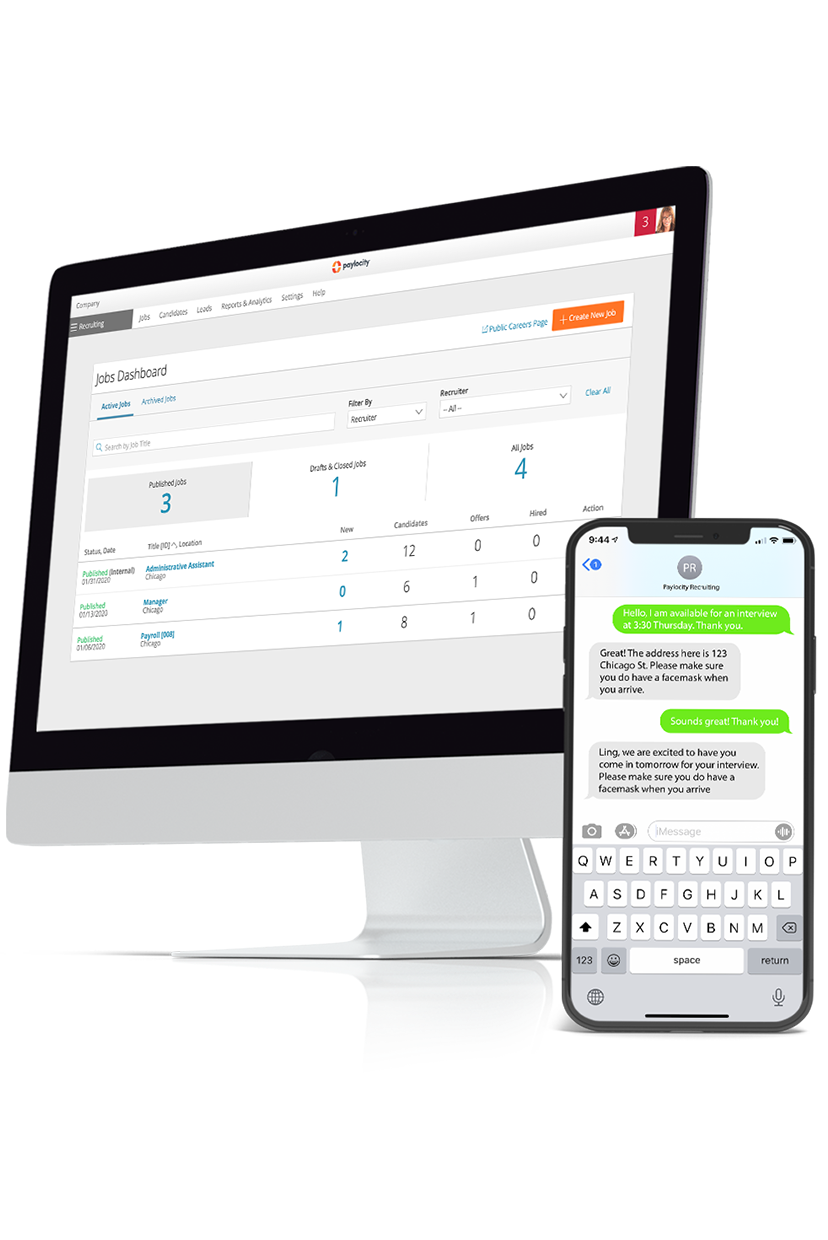
Finding the right talent for your team can be challenging in today’s market. But with the right tools, it doesn’t have to be a strain on your internal resources as well. Our recruiting platform streamlines the process, bringing you an intuitive way to search for and engage with top candidates. With communication methods like texting and video, and data that helps you track progress, attracting and winning has never been easier.

