
2026 E-Verify mandatory states

What is E-Verify?
E-Verify is a federal, web-based system operated by the U.S. Citizenship and Immigration Services (USCIS) in partnership with the Social Security Administration (SSA). It allows employers to confirm the employment eligibility of newly hired workers by comparing information from Form I-9 with federal records.
While all U.S. employers must obtain and submit an I-9 Form to verify a new hire’s identity and work authorization, E-Verify verification streamlines the process by electronically reviewing, investigating, and reporting information.
Key takeaways
- E-Verify is a federal program that electronically confirms a new hire’s employment eligibility by comparing I-9 Form data with government records.
- Certain states legally require employers to use E-Verify, while others only restrict or impose additional requirements on its use, making a firm understanding of local regulations essential.
- Penalties for noncompliance can range from fines to civil penalties to loss of business licensing.
Where is E-Verify mandatory?
Federally, E-Verify use is voluntary for most employers, except for federal contractors and subcontractors with an E-Verify clause in their contracts.
Conversely, several states have passed mandatory E-Verify laws requiring its use for all new employees. Some cities and local municipalities also have similar requirements, even if they’re not located in E-Verify states.
Other states, however, limit or restrict the use of E-Verify. For example, California prohibits using the program to screen applicants or existing employees, while Illinois requires employers to notify employees when they’re being verified and prohibits pre-employment E-Verify screening.
Employers should, therefore, consult with state and local agencies to determine the laws and requirements in their areas.
2026 states that require E-Verify

|
E-Verify states |
E-Verify requirements by state | State E-Verify law |
|---|---|---|
|
Alabama |
Mandatory for all private and public employers and federal contractors.
|
|
| Arizona
|
Mandatory for all private and public employers and federal contractors. | |
| California
|
Employers are prohibited from misusing the E-Verify system, including unlawful prescreening, improperly verifying existing employees, and failing to provide required notices.
|
|
|
Florida |
Mandatory for all public employers, federal contractors, and private employers with 25 or more employees. | Florida Statutes § 448.095 |
| Georgia | Mandatory for all public employers, federal contractors, and private employers with 10 or more employees. | Georgia Code § 13-10-91 |
| Idaho | Mandatory for all public employers. | Executive Order No. 2009-10 |
| Illinois | Employers must post the required E-Verify posters for prospective and current employees, and are prohibited from the misuse of the E-Verify system. | Public Act 103-879 |
| Indiana | Mandatory for all public employers and federal contractors. | Ind. Code § 22-5-1.7 |
| Louisiana | Mandatory for all private employers and private contractors for public entity projects. | Louisiana Revised Statutes § 23:995 |
| Michigan | Mandatory for certain public employers and their contractors. | Act No. 200, Public Acts of 2012 |
| Minnesota | Mandatory for all federal contractors for services valued in excess of $50,000. | Minn. Stat. § 16C.075 |
| Mississippi | Mandatory for all private and public employers. | Mississippi Code § 71-11-3 |
| Missouri | Mandatory for all public employers and federal contractors for services valued in excess of $5,000. | Mo. Rev. Stat. § 285.530 |
| Nebraska | Mandatory for all public employers and federal contractors. | Nebraska Revised Statute 4-114 |
| North Carolina | Mandatory for private employers with 25 or more employees and all public employers. | N.C. Gen. Stat. § 64-26 |
| Oklahoma | Mandatory for all public employers and federal contractors. | Okla. Stat. Title 25 § 1313 |
| Pennsylvania | Mandatory for public construction industry employers. | Act No. 141 of 2022 |
| South Carolina | Mandatory for all private employers with 25 or more employees and all public employers. | South Carolina Code § 41-8-10 |
| Tennessee | Mandatory for private employers with six or more employees. | Tennessee Code § 50-1-703 |
| Texas | Mandatory for all public employers and federal contractors. |
and |
| Utah | Mandatory for private employers with 150 or more employees, all public employers, and federal contractors. | Utah Code § 63G-12-302 |
| Virginia | Mandatory for all public employers with more than an average of 50 employees for the previous 12 months entering into a contract in excess of $50,000. | Va. Code § 2.2-4308.2 |
| Washington | Mandatory for federal contractors in certain counties and cities. | N/A* |
| West Virginia | Mandatory for the state’s Capitol Complex employers. | W. Va. Code § 21-1B |
*Refer to local agencies for area-specific laws and regulations.
Federal and state penalties for noncompliance
The Department of Homeland Security (DHS) may impose civil fines on employers who knowingly hire or continue to employ individuals who don’t have authorization to work in the U.S.
If a violation is suspected, the DHS will issue a Notice of Intent to Fine, giving the employer an opportunity to respond. Employers have 30 days from receipt of the notice to request a hearing and present their case. If a violation is confirmed, employers can face a range of financial penalties based on the situation:
- I-9 work form paperwork violations: $288 - $2,861
- Knowingly recruiting, referring, retaining, or hiring unauthorized workers
- First offense: $716 - $5,724 per worker
- Second offense: $5,724 - $14,308 per worker
- Third or more offense: $14,308 - $28,619
- Failing to inform DHS of continuing employment after a notice of final nonconfirmation: $973 – $1,942
States requiring E-Verify use can also impose varying penalties, including:
- Additional fines
- Loss of business license
- Contract termination (for public contractors)
- Civil penalties
Other employer considerations
Companies in E-Verify mandatory states should ensure that employees complete proper training to understand the E-Verify verification process. They can also visit the E-Verify website for additional employer and employee resources.
Furthermore, employers not in states that require E-Verify use can still voluntarily enroll and participate in the program, as it offers legal protection for companies that demonstrate good faith in verifying worker eligibility, thus minimizing liability in the event of an audit.
How does E-Verify work?
After a new hire employee submits the completed Form I-9 with acceptable documents, the employer will log into their E-Verify account and enter the relevant data (e.g., employee’s name, date of birth, social security number, etc.) for verification.
The program then cross-checks the information with the DHS and SSA databases.
Based on the information provided, employers will receive one of the following results:
- Employment Authorized: The employee’s information matched DHS and SSA records.
- E-Verify Needs More Time: This case was referred to the DHS for further verification.
- Tentative Nonconfirmation (aka E-Verify Mismatch): The information provided doesn’t match information in the DHS and/or SSA database(s), and additional action is required.
- Case in Continuance: The employee has contacted the DHS or visited an SSA field office, but more time is needed to determine a final case result.
- Close Case and Resubmit: The DHS or SSA requires the employer to close the case and create a new case for this employee. This result may occur when the employee’s U.S. passport, passport card, or driver’s license information is incorrect.
- Final Nonconfirmation: E-Verify can’t confirm the employee’s employment eligibility after the employee contacted the DHS or visited the SSA.
2026 I-9 form and E-Verify updates
In 2025, USCIS released an updated I-9 Form with revised language and document descriptions. Key changes include:
- “A noncitizen authorized to work” is now labeled “An alien authorized to work.”
- Updated Form I-9 Instructions and acceptable documents list.
- Enhanced integration with E-Verify+, which allows employees to securely manage their documents.
What is an I-9 form?
Form I-9 is a federal document U.S. employers must complete for every person they hire. Its purpose is to verify each new hire’s identity and authorization to work in the U.S.
Who completes the I-9 form?
Per Form I-9 instructions, newly hired employees must complete I-9 Form Section 1 on or before their first day of work.
Employers or an authorized representative must then complete I-9 Form Section 2 within three business days of the employee’s start date by physically reviewing original documents that prove the employee’s identity and work authorization.
Supplement B, however, is used for rehiring, name changes, or reverification of work authorization.
Form I-9 acceptable documents
Employees must present either one document from List A (proves both identity and work authorization), or one document from List B (identity) and one from List C (work authorization) within three business days of their start date. Examples include:
|
List A |
List B | List C |
|---|---|---|
|
|
|
Alternative options for E-Verify employers
Effective August 1, 2023, E-Verify enrolled employers who are in good standing have the option to remotely examine copies of accepted Form I-9 documents instead of physically reviewing them in person.
To qualify, all of the employer’s hiring sites must be enrolled in E-Verify, fully compliant with E-Verify requirements, and use the program to confirm every new hire’s employment eligibility.
Under this alternative procedure, E-Verify companies must:
- Receive and examine copies (front and back, if two-sided) of the employee’s I-9 Form documents.
- Conduct a live video interaction with the employee, during which the same documents must be presented to confirm they appear genuine and relate to the individual.
- Check the alternative procedure box on the August 2023 version of the I-9 Form or note “Alternative Procedure” in the Additional Information field on older versions.
- Retain clear and legible copies of all reviewed documents in case of audit or inspection.
Confidently handle compliance with Paylocity
E-Verify helps ensure compliance with immigration laws by reducing the risk of hiring unauthorized workers. But managing it and I-9 Forms shouldn’t have to be a burden.
With expert guidance and user-friendly technology, Paylocity makes compliance easier for everyone:
- An Onboarding solution that streamlines employee verification with automated, built-in tools for securely collecting and storing documentation while tracking work authorization expirations— all in one centralized, compliant system.
- Our E-Verify training course ensures company administrators handle every step of the process accurately and confidently.
- Robust documentation tools that easily upload, store, and retrieve important materials, such as Form I-9 and supporting documents.
Request a demo today to see how much easier onboarding and compliance can be.
About the Author
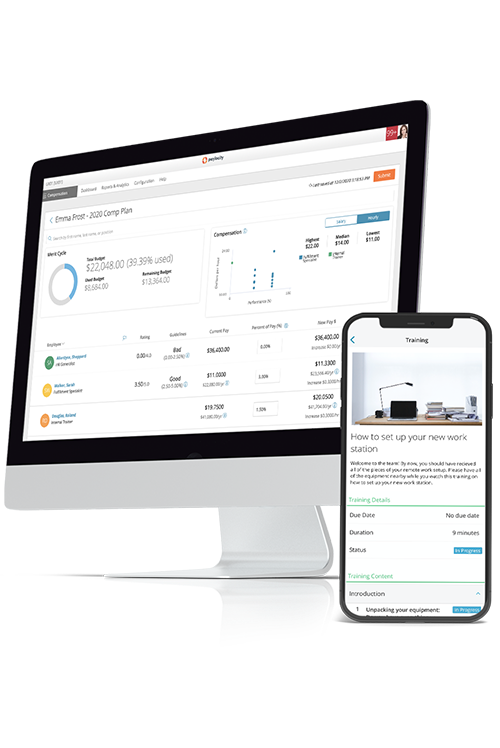
The tools you need to attract and retain
Attract, engage, and retain top talent with a comprehensive platform designed to support every stage of the employee journey. From recruiting and onboarding to development and retention, our tools offer a seamless experience that’s tailored to the needs of the modern workforce.
Related

HR’s Guide to the New I-9: FAQs on Remote Verification and More
