2025 Year-End Tax Alert
December 24, 2025

As tax year 2025 draws to a close, businesses should be aware that many new regulations will go into effect in 2026. The following is a brief description of the federal, state, and local updates that can affect employer payroll taxes.
Federal Tax Updates
On Thursday, July 3, 2025, Congress passed HR1, the One Big Beautiful Bill Act, and President Trump signed the Act into law during a special event on July 4. This act extends many provisions from the Tax Cuts and Jobs Act while introducing new payroll tax changes. This new law includes income tax deductions for qualified tips and qualified overtime. With these new changes, the Internal Revenue Service (IRS) issued new instructions for W-4 forms and changed reporting requirements for W-2 forms.
Federal Employment Taxes
The Social Security Administration (SSA) announced the Social Security wage base limit would increase to $184,500 for tax year 2026, an increase of $8,400 from $176,100, in 2025.
The Social Security and Medicare tax rate for tax year 2025 will remain unchanged. The Social Security tax rate remains at 6.2% for 2026 up to the Social Security wage base limit. The maximum Social Security tax employees and employers will each pay in 2026 is $11,439.00.
The Medicare tax rate for tax year 2025 remains at 1.45% and applies to all covered earnings for employees and employers. There is no wage base limit for Medicare. Additionally, if an individual’s earned income exceeds $200,000 ($250,000 for married couples filing jointly), the excess income is subject to an additional Medicare tax rate of 0.9%.
SECURE 2.0 Act
The SECURE (Setting Every Community Up for Retirement Enhancement) 2.0 Act of 2022 (Secure 2.0) issued several key provisions, including updates to catch-up contributions and auto-enrollments under Sections 109 and 101, respectively, for plan years beginning after December 31, 2025.
Super Catch-Up Contributions
Under Section 109 of the SECURE 2.0 Act, participants turning 60, 61, 62, and 63 in 2026 will be eligible for increased catch-up contributions for their retirement plans. This applies to 401(k), 403(b), and governmental 457(b) plans that currently offer catch-up contributions. This provision is optional for employers; therefore, each plan provider will decide whether to implement this feature in their retirement plans.
Participant Age in 2026 | 2026 Standard Annual Deferral Limit | Catch –Up Contributions for 2026 | Total 2026 Annual Contribution Limit |
50-59 or 64 & older | $24,500 | $8,000 | $32,500 |
60 - 63 | $24,500 | $11,250 | $35,750 |
Roth Catch-Up Wage Threshold
Under Section 109 of the SECURE 2.0 Act, participants turning 60, 61, 62, and 63 in 2026 will be eligible for increased catch-up contributions for their retirement plans. This applies to 401(K), 403(b), 408(k) SEP and 457 that offer catch-up contributions.
For high wage earners, the Roth catch-up wage threshold is $150,000, effective January 1, 2026. Plan sponsors will apply the threshold using prior year wages to determine status for the year.
Contribution Annual Limit Increases
The limit on annual contributions to an IRA has increased to $7,500 from $7000. The Secure 2.0 ACT amended the IRA catch-up contribution limit for individuals aged 50 to include an annual cost-of-living adjustment, raising it to $1,100, up from $1,000 for 2025.
IRS Guidance for State Paid Family and Medical Leave Programs
The IRS released Revenue Ruling 2025-04 (RR 25-04) on January 15, 2025, which provides guidance for states that have implemented paid family and medical leave (PFML) programs. Employer “pick up” contributions are taxable for federal income tax and employment taxes (i.e., FICA taxes).
Additionally, medical leave benefits paid to employees through state programs are considered taxable wages for federal purposes. Such payments are taxable for federal income and employment taxes, creating reporting requirements for the employee’s W-2 form. The IRS extended the transition period to calendar year 2026 for reporting employers’ FICA liability for medical leave benefits.
Upcoming Payroll Regulations
Below are notable payroll regulations going into effect during tax year 2026 that require employer and employee compliance.
IRS Notice 2026-6
On December 19, 2025, the IRS released Notice 2026‑6 extending the 2025 one‑year transition period into calendar year 2026. The extension only applies to medical leave benefits paid by states or employers that are attributable to employer contributions.
In response to IRS Notice 2026‑6, many state programs are revisiting their initial messaging and rolling back previously announced compliance directives.
Maryland Paid Family and Medical Leave
Maryland has postponed the implementation of its statewide Paid Family and Medical Leave (PFML) insurance program, which is funded by both employer and employee contributions.
PFML contributions will now begin on January 1, 2027, and eligible employees will be able to access benefits on January 1, 2028. Employees may receive up to 12 weeks of paid leave per year for family or medical reasons.
Refer to the Maryland Paid Family and Medical Leave article in PEAK for more information.
Minnesota Paid Leave
The first wage detail report for Minnesota’s paid family and medical leave insurance program (PFML) was due October 31, 2024. The program is funded through employer and employee contributions, and payroll premium contributions will start on January 1, 2026. Eligible employees will be able to access benefits at that time.
Refer to the state’s paid leave website for more information.
New Withholding Calculations for Tax Year 2026
Jurisdiction | Agency Resource |
U.S. | |
Arkansas | |
California | |
Colorado | |
Illinois | |
Indiana | |
Iowa | |
Kentucky | |
Maine | |
Minnesota | |
Missouri | |
Mississippi | |
Montana | |
Nebraska | |
New Mexico | |
New York | |
North Carolina | |
Oklahoma | |
Rhode Island | |
South Carolina |
State Minimum Wage Rates Effective January 1, 2026
Jurisdiction | 2025 Minimum Wage | 2026 Minimum Wage | Jurisdiction | 2025 Minimum Wage | 2026 Minimum Wage |
Alabama | $7.25 | $7.25 | Missouri | $13.75 | $15.00 |
Alaska | $11.91 | $14.00 | Montana | $10.55 | $10.85 |
Arizona | $14.70 | $15.15 | Nebraska | $13.50 | $15.00 |
Arkansas | $11.00 | $11.00 | Nevada | $12.00 | $12.00 |
California | $16.50 | $16.90 | New Hampshire | $7.25 | $7.25 |
Colorado | $14.81 | $15.16 | New Jersey | $15.49 (large employer) & $14.53 (small employer) | $15.92(large employer) & $15.23(small employer) |
Connecticut | $16.35 | $16.94 | New Mexico | $12.00 | $12.00 |
Delaware | $15.00 | $15.00 | New York | $16.50 New York City, Nassau, Suffolk, & Westchester counties; the rest of the state: $15.50 | $17.00 New York City; Nassau, Suffolk and & Westchester. Remainder of New York is $16.00 per hour |
District of Columbia | $17.50 | $17.95 | North Carolina | $7.25 | $7.25 |
Federal | $7.25 | $7.25 | North Dakota | $7.25 | $7.25 |
Florida | $13.00 | $14.00 | Ohio | $10.70 | $11.00 |
Georgia | $7.25 | $7.25 | Oklahoma | $7.25 | $7.25 |
Hawaii | $14.00 | $16.00 | Oregon | 14.70 | $15.05 |
Idaho | $7.25 | $7.25 | Pennsylvania | $7.25 | $7.25 |
Illinois | $15.00 | $15.00 | Rhode Island | $15.00 | $16.00 |
Indiana | $7.25 | $7.25 | South Carolina | $7.25 | $7.25 |
Iowa | $7.25 | $7.25 | South Dakota | $11.50 | $11.85 |
Kansas | $7.25 | $7.25 | Tennessee | $7.25 | $7.25 |
Kentucky | $7.25 | $7.25 | Texas | $7.25 | $7.25 |
Louisiana | $7.25 | $7.25 | Utah | $7.25 | $7.25 |
Maine | $14.65 | $15.10 | Vermont | $14.01 | $14.42 |
Maryland | $15.00 | $15.00 | Virginia | $12.41 | $12.77 |
Massachusetts | $15.00 | $15.00 | Washington | $16.66 | $17.13 |
Michigan | $10.56 | $13.73 | West Virginia | $8.75 | $8.75 |
Minnesota | $11.13 | $11.41 | Wisconsin | $7.25 | $7.25 |
Mississippi | $7.25 | $7.25 | Wyoming | $5.15 | $5.15 |
Local Minimum Wage Rates Effective January 2026
State, Locality | Minimum Wage | State, Locality | Minimum Wage |
AZ, Flagstaff | $18.35 | CO, Boulder (City) | $16.82 |
AZ, Tucson | $15.45 | CO, Boulder County | $16.82 |
CA, Belmont | $18.95 | CO, Denver | $19.29 |
CA, Burlingame | $17.86 | CO, Edgewater | $18.17 |
CA, Cupertino | $18.70 | IL, Chicago | $16.60 |
CA, Daly City | $17.50 | MD, Howard County | Large Employer $16.00 |
CA, East Palo Alto | $17.90 | MD, Montgomery County (Mid size) | Large Employer $17.65 |
CA, El Cerrito | $18.82 | ME, Rockland City | $16.00 |
CA, Foster City | $17.85 | MN, Minneapolis | $16.37 |
CA, Half Moon Bay | $17.91 | MN, St. Paul | Large Employer $16.37 |
CA, Hayward | Large Employers $17.79 | NM, Albuquerque | $12.00 |
CA, Los Altos | $18.70 | NM, Las Cruces | $13.01 |
CA, Menlo Park | $17.55 | NY, Bronx County | $17.00 |
CA, Mountain View | $19.70 | NY, Kings County | $17.00 |
CA, Novato | Large Employer $17.73 | NY, Nassau County | $17.00 |
CA, Oakland | $17.34 | NY, NYC and County | $17.00 |
CA, Palo Alto | $18.70 | NY, Queens County | $17.00 |
CA, Petaluma | $18.31 | NY, Richmond County | $17.00 |
CA, Redwood City | $18.65 | NY, Suffolk County | $17.00 |
| CA, Richmond | $19.18 | NY, Westchester County | $17.00 |
CA, San Carlos | $17.75 | WA, Bellingham | $19.13 |
CA, San Diego | $17.75 | WA, Everett | Large Employers $20.77 |
CA, San Jose | $18.45 | WA, King County-Unincorp. Areas | Large Employer $20.82 |
CA, San Mateo | $18.60 | WA, Renton | Large Employers $21.57 |
CA, Santa Clara | $18.70 | WA, SeaTac | $20.74 |
CA, Santa Rosa | $18.21 | WA, Seattle | $21.30 |
CA, Sonoma | Large Employers $18.47 | WA, Tukwila | $21.65 |
CA, South San Francisco | $18.15 |
| |
CA, Sunnyvale | $19.50 |
|
|
CA, West Hollywood | Hotel workers: $20.22 |
|
|
State Unemployment Insurance Wage Base Limits
Jurisdiction | 2025 Taxable Wage base | 2026 Taxable Wage Base | Jurisdiction | 2025 Taxable Wage base | 2026 Taxable Wage Base |
Alabama | $8,000 | $8,000 | Montana | $45,100 | $47,300 |
Alaska | $51,700 | $54,200 | Nebraska | $9,000 | $9,000 |
Arizona | $8,000 | $8,000 | Nevada | $41,800 | $43,700 |
Arkansas | $7,000 | $7,000 | New Hampshire | $14,000 | $14,000 |
California | $7,000 | $7,000 | New Jersey | $43,300 | $44,800 |
California SDI | No Limit | No Limit | New Jersey TDI EE | $165,400 | $171,100 |
Colorado | $27,200 | $30,600 | New Mexico | $33,200 | $34,800 |
Connecticut | $26,100 | $27,000 | New York | $12,800 | $17,600 |
Delaware | $12,500 | $14,500 | North Carolina | $32,600 | $34,200 |
District of Columbia | $9,000 | $9,000 | North Dakota | $45,100 | $46,600 |
Federal | $176,100 | $184,500 | Ohio | $9,000 | $9,000 |
Florida | $7,000 | $7,000 | Oklahoma | $28,200 | $25,000 |
Georgia | $9,500 | $9,500 | Oregon | $54,300 | $56,700 |
Hawaii | $62,000 | $64,500 | Pennsylvania | $10,000 | $10,000 |
Idaho | $55,300 | $58,300 | Puerto Rico | $7,000 | $7,000 |
Illinois | $13,916 | $14,250 | Rhode Island | $29,800 | $30,800 |
Indiana | $9,500 | $9,500 | South Carolina | $14,000 | $14,000 |
Iowa | $39,500 | $20,400 | South Dakota | $15,000 | $15,000 |
Kansas | $14,000 | $15,100 | Tennessee | $7,000 | $7,000 |
Kentucky | $11,700 | $12,000 | Texas | $9,000 | $9,000 |
Louisiana | $7,700 | $7,000 | Utah | $48,900 | $50,700 |
Maine | $12,000 | $12,000 | Vermont | $14,800 | $15,400 |
Maryland | $8,500 | $8,500 | Virgin Island | $31,100 | $31,100* |
Massachusetts | $15,000 | $15,000 | Virginia | $8,000 | $8,000 |
Michigan | $9,000 | $9,000 | Washington | $72,800 | $78,200 |
Minnesota | $43,000 | $44,000 | West Virginia | $9,500 | $9,500* |
Mississippi | $14,000 | $14,000 | Wisconsin | $14,000 | $14,000 |
Missouri | $9,500 | $9,000 | Wyoming | $32,400 | $33,800 |
* 2026 rate has not been published.
Paid Family and Medical Leave Rates Effective January 1, 2026
Jurisdiction | 2026 Rate | Paid By | ||||||||||||||||||
California | 1.2% | Employees | ||||||||||||||||||
Colorado | 0.88% | Employer & Employee
| ||||||||||||||||||
Connecticut | 0.5% | Employees | ||||||||||||||||||
District of Columbia | 0.75% | Employers | ||||||||||||||||||
Massachusetts | 0.88%
Medical: 0.70%
Family: 0.18% | The contribution total rate is 0.88 % Employer & Employees 25 or more employees
24 or fewer employees
| ||||||||||||||||||
New Jersey | 0.23% | Employees | ||||||||||||||||||
New York | 0.432% | Employees | ||||||||||||||||||
Oregon | 1.00% | 1% up to the wage cap
| ||||||||||||||||||
Rhode Island | 1.3% | Employees | ||||||||||||||||||
Washington | 1.13% | Employers & Employees |
Thank you for choosing Paylocity as your valued service partner. This information is provided as a courtesy, may change, and is not intended as legal or tax guidance. Employers with questions or concerns outside the scope of a Payroll Service Provider are encouraged to seek the advice of a qualified CPA, Tax Attorney, or Advisor.
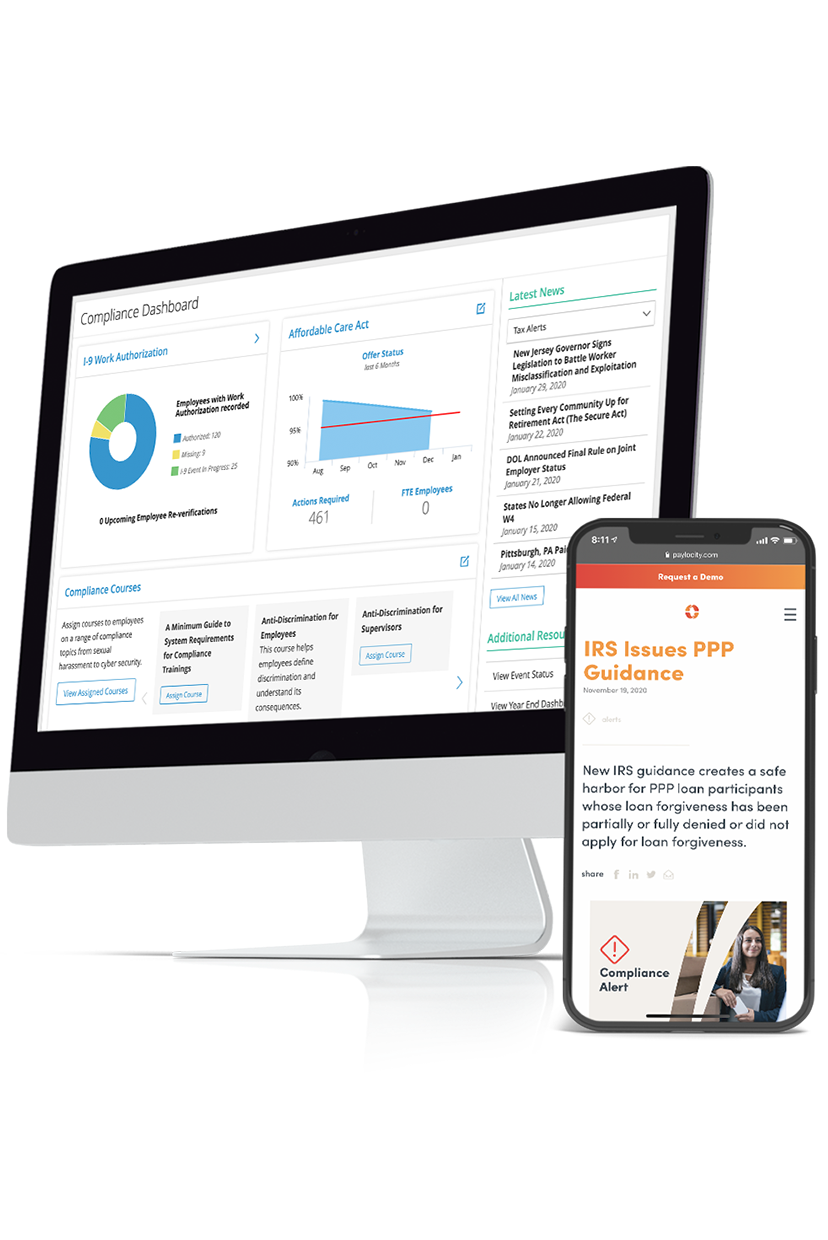
Keep Up With Compliance
Between constantly changing employment laws and updates to the Affordable Care Act (ACA), keeping your workplace compliant can be a time-consuming and costly challenge. Eliminate the stress and stay up to date with our Compliance Dashboard. View compliance alerts and get a bird’s eye view of what you need to do to avoid fines and penalties.