HCM Compliance Year-End Review
December 02, 2025

Federal Updates
Roth Catch-up Requirement for Certain Employees
Effective January 1, 2026, employees making catch-up contributions into a 401(k), 403(b), or governmental 457 retirement plan must make said contributions on a post-tax, Roth IRA basis, if the employee meets a certain wage threshold ($150,000 in FICA-eligible wages, based on Form W-2 Box 3 earnings from the employer sponsoring the plan.
2026 Plan Limits for FSAs and Other Plans
2026 HSA Annual Contribution Limit
Coverage Level | Amount |
Self-Only Coverage | $4,400 |
Family Coverage | $8,750 |
Catch-Up Coverage (Age 55 or older) | $1,000 |
2026 High Deductible Health Plan Requirements
Coverage Level | Minimum Annual Deductible | Maximum Annual Out-of-Pocket Limit |
| Individual | $1,700 | $8,500 |
Family | $3,400 | $17,000 |
2026 Plan Limit Increases for FSAs and Other Plans
Benefit Plan | 2026 Limit | Change from 2025 |
| Health FSA | $3,400/year | +$100 |
Health FSA Carryover | $680/year | +$20 |
| Qualified Commuter and Transit Benefits | $340/month | +$15 |
| Qualified Parking | $340/month | +$15 |
| QSEHRA Payments and Reimbursements (single coverage) | $6,450/year | +$100 |
| QSEHRA (family coverage) | $13,100/year | +$300 |
| EBHRA | $2,200/year | +$50 |
Alabama Updates
Independent Contractor Portable Benefit Accounts
Effective December 31, 2025, Alabama employers may use "Portable Benefit Accounts" to offer eligible independent contractors certain tax-advantaged benefits, including health insurance, retirement savings, and life insurance, among others.
California Updates
Equal Pay Act Amendments
Effective January 1, 2026, a few pay act amendments will go into effect:
- The pay scale listed on job postings must be the salary or hourly wage range the employer, in good faith, reasonably expects to pay “upon hire.”
- The definition of “wages” will expand to include all forms of pay, including stock options, vacation pay, work travel expenses, and accommodations and benefits.
- The prohibition against sex discrimination will expand to prohibit paying employees of “another” sex less for performing substantially similar work, thus removing binary gender references."
Pay Data Report Amendments
Effective January 1, 2026, employers must collect and store (separately from employees’ personnel records) any demographic information gathered by an employer or labor contractor for the purpose of submitting the pay data report.
Furthermore, the job categories used in the report will expand to 23 on January 1, 2027.
Illegally Withheld Gratuities Enforcement Provisions
Effective January 1, 2026, the California Labor Commissioner can investigate and issue citations, or file civil action, for gratuities taken or withheld in violation of Labor Code Section 351.
Penalties include $100 for each initial violation, $250 for each subsequent violation, plus wages and liquidated damages.
Paid Sick & Safe Time Covered Uses Expansion
Effective January 1, 2026, an employee may use leave if they or a family member is a victim of certain crimes and is attending judicial proceedings related to that crime.
Personnel Records Amendment
Effective January 1, 2026, an employer who maintains education or training records must respond (within 30 calendar days) to written requests for record inspections or copies. Records must include all of the following:
- Employee’s name
- Trainer’s name
- Duration and date of the training
- Training’s core competencies, including skills in equipment or software
- Resulting certification or qualification
Know Your Rights Act
Effective February 1, 2026, employers must provide an annual written notice to each current employee that explains the right to workers’ compensation benefits and certain workers’ protections against unfair immigration-related practices and their constitutional rights when interacting with law enforcement in the workplace.
Furthermore, if requested by the employee, employers must also notify the employee’s designated emergency contact in the event the employee is arrested or detained at work. Employers must give employees an opportunity to designate this emergency contact no later than March 30, 2026, (or at the time of hire for employees hired after that date).
Colorado Updates
Paid Family & Medical Leave Amendment
Effective January 1, 2026, eligible employees may take up to an additional 12 weeks of leave for a child receiving care in a neonatal intensive care unit (NICU).
Connecticut Updates
Paid Sick Leave Amendment
Effective January 1, 2026, employers with 11 or more employees are required to provide paid sick leave. Refer to our Connecticut Paid Sick Leave Amendments article in PEAK for more information.
Illinois Updates
Blood and Organ Donation Leave Act Amendments
Effective January 1, 2026, part-time employees will be eligible for blood and organ donor leave (up to 10 days of leave per 12-month period.
Victims Economic Security and Safety Act Amendments
Effective January 1, 2026, employees are expressly permitted to use employer-issued electronic devices (e.g., phones or computers) to record incidents of domestic violence, sexual violence, gender violence, or other crimes committed against themselves or their family or household members.
Furthermore, employers are prohibited from disciplining or retaliating against employees for making such recordings.
Qualifying Dependent Parent or Stepparent Health Coverage
Effective January 1, 2026, an eligible Illinois group or individual policy for accident and health insurance that is issued, amended, delivered, or renewed after January 1, 2026, must make any dependent coverage it provides available to an eligible parent or step-parent.
Neonatal Intensive Care Leave
Effective June 1, 2026, employers with 16 to 50 employees must provide 10 days (20 days for employers with 51 or more employees) of unpaid neonatal intensive care leave for an employee with a child who is a patient in a neonatal intensive care unit.
Minnesota Updates
Meal & Rest Break Requirements
Effective January 1, 2026, employers must allow each employee a paid break of at least 15 minutes or enough time to use the nearest convenient restroom, whichever is longer. Furthermore, employers must allow an employee working at least 6 consecutive hours an unpaid meal break of at least 30 minutes.
Paid Sick Leave - Notice and Advance of Accruals Requirements
Effective January 1, 2026, employers may require up to 7 days' advance notice of the intention to use paid sick leave, if the need for said leave is foreseeable. If the need is unforeseeable, an employee may have to give notice of sick and safe time use, “as reasonably required by the employer.”
Yet, if an employer requires advanced notice, it must have a written policy that contains the notice requirements, which must also be provided to employees in writing.
Additionally, employers may provide earned sick and safe time to an employee in advance of accrual, based on the number of hours the employee is anticipated to work for the remainder of the 12-month benefit period. If an employee works more than anticipated, the employer must provide additional earned sick and safe leave to make up the difference.
New Hampshire Updates
Prenatal Unpaid Leave
Effective January 1, 2026, employers with 20 or more employees will be required to provide said employees with up to 25 hours of unpaid leave to attend either:
- their own medical appointments for childbirth or postpartum care; or
- their child’s pediatric medical appointments within the first year of the child’s birth or adoption
New York Updates
New York City – Paid Sick and Safe Time Amendments
Effective February 22, 2026, the permissible uses of paid sick and safe time will expand. Employers will also be required to provide an additional 32 hours of unpaid sick and safe time immediately at the time of hire, and frontload the time at the beginning of a new 12-month benefit period.
Note, this bank of hours is in addition to the 20-hour paid prenatal leave requirement that became effective on July 2, 2025.
Refer to our New York City Paid Sick Leave article in PEAK for more information.
Ohio Updates
Pay Transparency & Salary History Ban
Effective December 3, 2025 (though not enforced until January 1, 2027), employers with 15 or more people within the city of Columbus are prohibited from inquiring about a job applicant’s salary history.
Moreover, employers must provide a reasonable salary range or scale for potential employment in all postings for positions to be performed within city limits.
Oregon Updates
Paid Sick Leave Amendment
Effective January 1, 2026, employees will be permitted to use paid sick leave for blood donations.
Wage Theft Notice – Wage Statements
Effective January 1, 2026, owners and direct contractors are jointly and severally liable for any unpaid wages and fringe benefit contributions owed to unrepresented construction workers of the direct contractor or subcontractors of a construction contract.
Pennsylvania Updates
Pittsburgh Paid Sick Leave Amendment
Effective January 1, 2026, employees in Pittsburgh will accrue paid sick leave at a rate of one hour for every 30 hours worked, rather than every 35 hours worked. Moreover, employers with 15 or more employees will be required to provide at least 72 hours of paid sick leave annually, while those with fewer than 15 employees will have to provide at least 48 hours.
Refer to our Pittsburgh, PA Paid Sick Leave article in PEAK for more information.
Veteran’s Benefits & Services Workplace Posting Act
Effective January 1, 2026, employers with a Pennsylvania-based worksite that has 50 or more full-time employees must post workplace information related to veterans’ benefits and services. The Pennsylvania Department of Labor and Industry will create a uniform posting for employers to use.
Rhode Island Updates
Time of Hire – Notice Requirements
Effective January 1, 2026, employers must provide each employee with an English-written notice containing the following information:
- Pay rates and the basis for them
- Allowances claimed pursuant to permitted meals and lodging, if any
- Any policies on sick, vacation, and personal leave, holidays, and hours
- The employee’s employment status and whether they’re exempt from minimum wage and/or overtime pay
- Deductions that may be made from the employee's pay
- The number of days in the pay period, the regularly scheduled payday, and the payday on which the employee will receive the first payment of earned wages
- The employer’s:
- legal name and any different operating names
- main office or principal place of business’s physical address and any different mailing address(es); and
- telephone number
Paid Leave - Organ & Bone Marrow Donors
Effective January 1, 2026, employers must provide full-time employees with up to five days of paid leave for recovery after a bone marrow donation and up to 30 days for recovery following a living organ donation.
Washington Updates
Meal & Rest Break Requirements – Hospital Workers
Effective January 1, 2026, certain healthcare employees will have the option to waive meal breaks for any shift less than eight hours. Those with longer shifts will have the option to waive their second or third meal break, provided they take at least one meal break during their shift.
For more information, refer to our 2025 Midyear HCM Alert or 2025 HCM Year End Review article in PEAK.
Thank you for choosing Paylocity as your valued service partner. This information is provided as a courtesy, may change, and is not intended as legal or tax guidance. Employers with questions or concerns outside the scope of a Payroll Service Provider are encouraged to seek the advice of a qualified CPA, Tax Attorney, or Advisor.
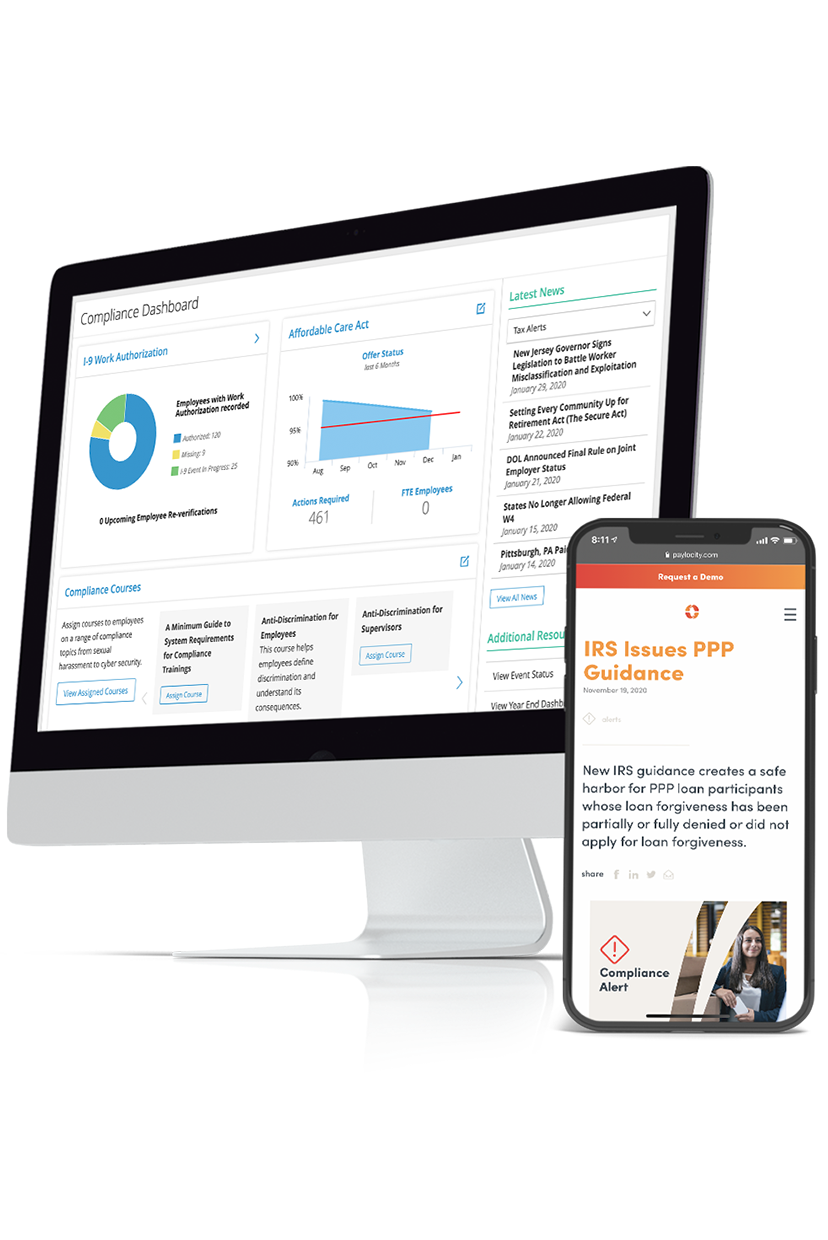
Keep Up With Compliance
Between constantly changing employment laws and updates to the Affordable Care Act (ACA), keeping your workplace compliant can be a time-consuming and costly challenge. Eliminate the stress and stay up to date with our Compliance Dashboard. View compliance alerts and get a bird’s eye view of what you need to do to avoid fines and penalties.