Flextime
Summary definition: A scheduling arrangement that allows employees to vary their start and end times while still meeting a set number of required work hours.
What does flextime mean?
Flextime, also known as flex time or flexi time, is a work schedule arrangement that gives employees control over when their workday begins and ends, provided those times fall within certain parameters (e.g., minimum hours worked threshold or required core hours availability).
Rather than adhering to a fixed schedule, employees with flex hours can shift their working hours to better align with personal needs.
Key takeaways
- Flextime is a scheduling agreement wherein employees can vary their start and end times within employer-set windows and parameters.
- With flex hour jobs, employees can adjust their schedules to fit their lives, reducing the risk of burnout and turnover.
- A written flex work policy ensures consistent company-wide adoption, avoiding mismatched expectations or risk of unfair use.
How does flextime work?
Most flex scheduling is structured around a core window of hours or a block of time during which all employees must be available, regardless of their chosen start or end times.
Outside that window, employees have latitude to build a flex work schedule that suits their needs. Examples include:
| Model | How it works |
| Variable day | Employees choose daily start/end times within an approved range (e.g., arrive anytime between 7:00 and 10:00 a.m.). |
| Compressed workweek | Employees work longer days in exchange for a shorter week (e.g., four 10-hour days or a 9/80 schedule). |
| Gliding schedule | Employees set their own hours (i.e., no core hours window) during a standard workweek, so long as they work the required total hours (e.g., 40 hours per week). |
| Maxiflex | Similar to a gliding schedule, except employees can vary both working day hours and days worked each calendar week (e.g., work eight hours a day, Tuesday through Saturday). |
Flextime vs. other flexible work arrangements
Because it’s easy to conflate flex time with flexible work arrangements, HR teams should clarify which model they're implementing and explicitly communicate the distinction to managers and employees.
| Arrangement | Details |
|---|---|
| Flextime | When employees work |
| Remote work | Where employees work |
| Part-time | How many hours employees work |
| Job sharing | What employees work on or delegate to others |
| Results-only work environment (ROWE) | Total schedule and set-up freedom, provided work meets quality and timing requirements |
What are the benefits of flex time?
By balancing schedule flexibility with performance needs, flextime is an extremely cost-effective, mutually beneficial agreement for both employees and employers.
- For employees: A flextime work schedule mitigates friction between work and personal obligations, increasing employee work-life balance and reducing the risk of burnout.
- For employers: Flexible time arrangements expand the talent pool by including candidates who can't meet traditional working schedules. Moreover, research shows that workplace flexibility affects worker loyalty to their employer.
How to build a flex time policy
A well-designed flexible time policy should provide a framework for consistent employee use and set clear expectations up front. Important flextime schedule components to address include:
- Eligibility: Define which roles or departments qualify for flexible timing schedules and whether employees must meet any performance thresholds before they can participate.
- Core hours: Establish the window during which all employees must be available, regardless of their chosen start and end times.
- Scheduling process: Specify how employees request and confirm their flex hours, including the required advance notice and who approves changes.
- Time tracking: Establish how to document flextime, meaning how requests are approved and hours are recorded, particularly for employees where accurate timekeeping is a compliance requirement (e.g., non-exempt employees).
- Technology: Identify the flextime application or scheduling software that’ll support the policy. Prioritize a flextime app or scheduling platform with tools that automate scheduling requests, time tracking, and manager approvals.
- Review cadence: Set a schedule for revisiting arrangements, including the conditions that would trigger a modification or revocation.
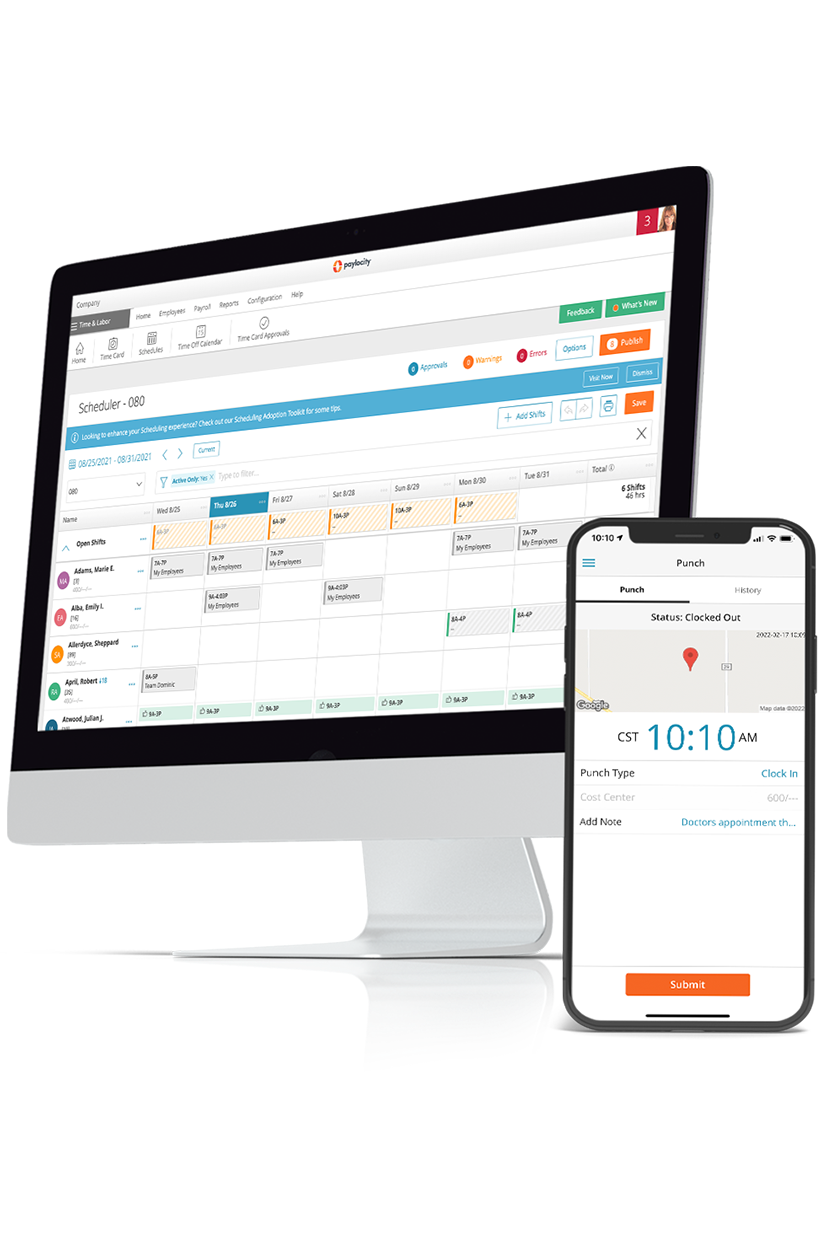
Maximize productivity the right way
Get out of time-consuming processes while knowing your employees are set up for day-to-day success. The costs — and headaches — of manually scheduling, tracking, and managing your workforce's time adds up fast. Use the right tools to automate where it matters, while delivering a modern, user-friendly experience for employees and their managers.