Embedded AI keeps people at the heart of HR

When big changes happen at work, they naturally bring feelings of uncertainty, and the current AI shift is no different. People worry about their jobs, whether AI will get things right, and what happens if it doesn’t. Trust me, I hear the same concerns from friends in HR around the country.
But in our recent chat on the HR Mixtape podcast, leadership and emotional intelligence expert Dr. Bushra Kahn offered some great advice: Don’t panic. Instead, embrace how AI can make your and your teams’ jobs easier.
“(People say), ‘What's going to happen to my job? AI is going to ruin it,’” Khan said. “It's people who know how to use AI, the people who are emotionally intelligent and have a really strong sense of understanding how the tech is evolving — they are going to take over.”
The teams getting the most out of AI today are using it to take tedious, time-consuming work off their plates so they can spend more time on what matters most: strategy, big decisions, and the human conversations that AI just can’t replace.
How are HR teams using AI?
More and more HR teams are using AI tools in their day-to-day work to automate repetitive tasks like scheduling, screening, and reporting, as well as to uncover useful insights from existing data and help guide decisions.
Take hiring, for instance. A well-designed AI recruiting tool doesn't make the decision for you. It helps your team move faster by highlighting qualified candidates, spotting gaps, and cutting down on manual screening. Your recruiters still make the final call. They just get there faster and with better information.
That matters, because hiring the right people is what builds a strong, productive team. When I caught up with Steven Puri on a recent HR Mixtape episode, he said when you feel confident you’ve hired the right people, you can give them the space to do their best work, including the deep, focused thinking that leads to real breakthroughs.
“Almost everything comes down to this — did you hire well?” said Puri, founder of The Sukha Company, which helps teams improve focus and wellbeing through practical tools that reduce stress and burnout. “If you hire well, then you say to someone, ‘On Tuesdays and Thursdays, I want you to take two hours, block out your calendar, don’t talk to anyone, and I want you to go deep and find those ideas.’ That all starts with hiring, because you have to trust those people.”
Recruitment is a great example of how AI boosts what HR pros do by giving them time and space to nurture top candidates and connect them with the right hiring managers. That same kind of AI support is magnified when it flows across all your HR processes, giving you smarter tools and clearer insights at every stage of the employee lifecycle.
Why is built-in AI better than bolted on?
When AI is embedded natively into your HCM platform, there may be a learning curve at first. But team members tend to quickly see how much more they can get done, and how much faster they can do it, all within the same system they use every day.
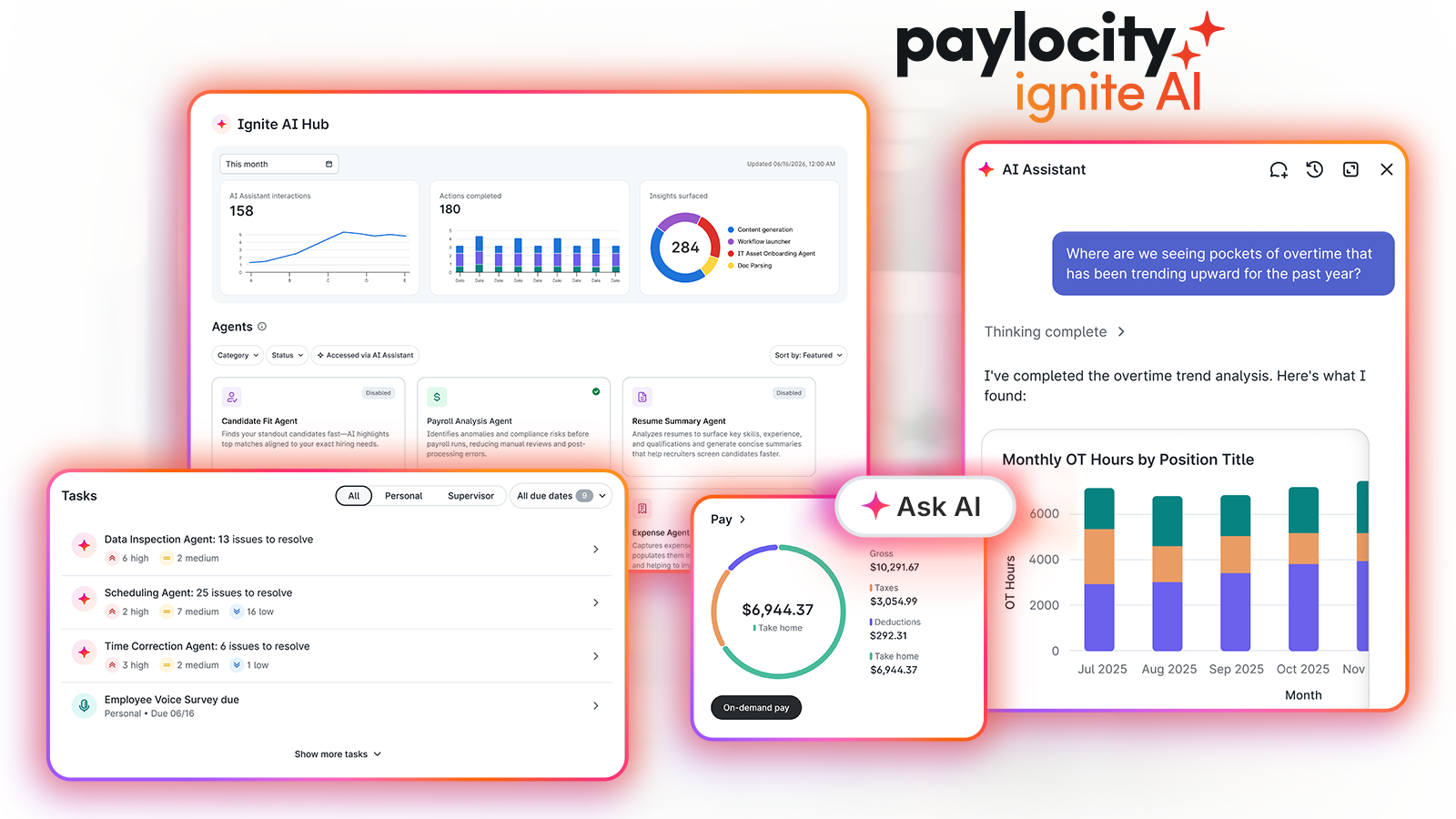
When AI is just added on top of an existing system, it can add more complexity, including new interfaces, new data flows, and more opportunities for things to slip through the cracks. Embedded AI works within the system your team already knows, using the data you already have. Instead of making things more complicated, it can handle those mundane tasks, surface workforce insights, and support better decision-making.
With AI, HR teams speed up recruiting without sacrificing quality, with analytics that give leaders the data they need to make the case for workforce investment, and automation that reduces the manual work that slows teams down.
The result isn't just better efficiency. Embedded AI helps teams increase their strategic impact, prove ROI, and operate with the confidence that comes from having reliable, accurate, and well-managed data.
Surfacing insights across HR, Finance, and IT
Data only matters if people can actually do something with it. HR teams already know how to ask the right questions. They understand context, know their people, and they can spot when a number doesn't tell the whole story. AI builds on that instinct. It doesn't replace it.
When AI is connected across your HR, finance, and IT data, it can spot patterns your team might not have the time to uncover on their own. You get both the big-picture view and the granular detail that points to specific, corrective action. Turnover trends by department, pay gaps, benefits usage, and workforce costs compared to productivity: these insights help you make confident, data-driven decisions instead of relying on gut feel.
They also help you deliver the kinds of metrics that drive the change executives want to see. For senior leaders reporting to exec teams and boards, that’s the difference between just presenting data and using it to shape more impactful business decisions.
Keeping people in charge of decisions
Just like the internet changed everything three decades ago, AI is changing the way we live and work today. But no matter how much the technology evolves in the years ahead, HR will always be in the people business. We’re seeing how AI can be a great support tool for both individual contributors and leaders alike, but it can’t replace their judgement.
Lisa McConnell, founder of Steeped Leadership LLC, which serves as a bridge between the worlds of compliance, AI, and modern leadership, echoed that sentiment during our conversation on a recent HR Mixtape podcast.
“I really think that partnership is key in anything we do with AI. There always needs to be a human in a loop,” McConnell said. “There always needs to be someone looking at the oversight of the output and decisions that are made. It should never be something where we farm out decision-making.”
Whether you’ve already implemented AI as part of your HCM system or you’re still looking for the right fit, keep one thing in mind: AI can’t replace the need for talented, experienced people. It just raises the bar for what they can accomplish. Share that message with your team, and you’ll go a long way toward easing any worries they have about what AI means for their roles and their future.
Dr. Shari Simpson is host of the HR Mixtape podcast and Senior Manager of Thought Leadership at Paylocity, with 20+ years of strategic HR experience.