Candidate scoring
Summary Definition: A method of assigning applicants a numeric or categorical value based on how well they match a defined set of job criteria.
What is candidate scoring?
Candidate scoring is a recruiting method that rates applicants against predetermined criteria, such as required skills, years of experience, education, and assessment performance.
Instead of forming an impression from a resume alone, recruiters score each candidate against objective hiring criteria on the same rubric, which reduces bias and offers hiring decision support.
Key takeaways
- Candidate scoring rates every applicant against the same predetermined criteria, such as skills, experience, and assessment results, so hiring decisions rely on a consistent standard instead of gut instinct.
- Scoring works by defining criteria, assigning weights based on importance, and applying those weights consistently across every applicant to produce a single comparable score.
- A candidate scorecard organizes these weighted criteria into a structured document that recruiters and hiring managers can use at every stage of the hiring process, feeding consistent data into broader recruitment analytics.
Scoring vs. ranking
Scoring and ranking are often used together, but they answer different questions:
- Candidate scoring measures a candidate against a fixed standard: This relies on objective hiring criteria applied consistently, so a candidate who scores 85/100 on a technical assessment hits that mark whether they're the only applicant or one of 50.
- Candidate ranking orders candidates relative to one another within a specific applicant pool: For example, that same candidate might rank #1 in a pool of five average applicants but rank #4 if four other applicants scored 90 or above.
How does candidate scoring work?
Candidate scoring starts by defining the criteria that matter most for a role, then assigning weights to reflect their importance as they relate to the position. Those weights are then applied consistently across every applicant, often through automated screening tools that apply the rubric at scale.
The result is a single score or a set of subscores hiring teams can use to compare candidates side by side.
Candidate scoring techniques
Candidate scoring methods vary in how they weigh objective criteria against subjective judgment, and most hiring teams combine several to cover different parts of the evaluation:
- Skills-based scoring: Rates candidates on specific technical or soft skills tied to the role, often through assessments, work samples, or structured interview questions.
- Weighted criteria scoring: Assigns different point values to criteria based on importance, such as weighting relevant experience more heavily than education.
- AI candidate scoring: Uses machine learning models to analyze resumes, application responses, and assessment results, then generates a score based on patterns associated with successful past hires. Agentic AI can help identify the most effective criteria to surface the strongest candidates.
- Behavioral and competency scoring: Evaluates interview responses against defined competency frameworks, such as problem-solving or collaboration.
Example candidate scorecard
Recruiters and hiring managers can use scorecards at every stage of the process, from resume screening through final interviews, so every candidate is measured the same way and hiring decisions are easier to defend.
Here’s an example:
| Criteria | Weight | Score (1-5) | Weighted Score |
|---|---|---|---|
| Technical skills |
40%
|
4 | 1.6 |
| Relevant experience |
30%
|
3 | 0.9 |
| Communication skills |
20%
|
5 | 1.0 |
| Culture fit | 10% | 4 | 0.4 |
| Total | 100% | - | 3.9 |
Benefits of candidate scoring
A structured scoring process pays off at nearly every stage of hiring, from cutting down screening time to giving teams a defensible record if a decision gets questioned later:
- Protects the candidate experience: Applicants who endure a slow, disorganized process often accept another offer before a company reaches a decision, so a scoring system that moves candidates through the pipeline quickly helps bring in top talent.
- Improves consistency: Every applicant is measured against the same rubric, so evaluations don't shift based on who's reviewing the resume or when in the process it happens.
- Speeds up screening: Automated scoring tools can apply criteria at scale, helping recruiters manage heavy requisition loads without sacrificing hiring quality.
- Supports defensible decisions: A documented scorecard gives hiring teams a clear, criteria-based rationale to show that a decision was based on points, not personal preference, which matters if a hiring choice is ever challenged.
- Strengthens data-driven hiring: Consistent scores feed into broader recruitment analytics, helping HR teams demonstrate measurable outcomes as hiring becomes an increasingly numbers-driven function.
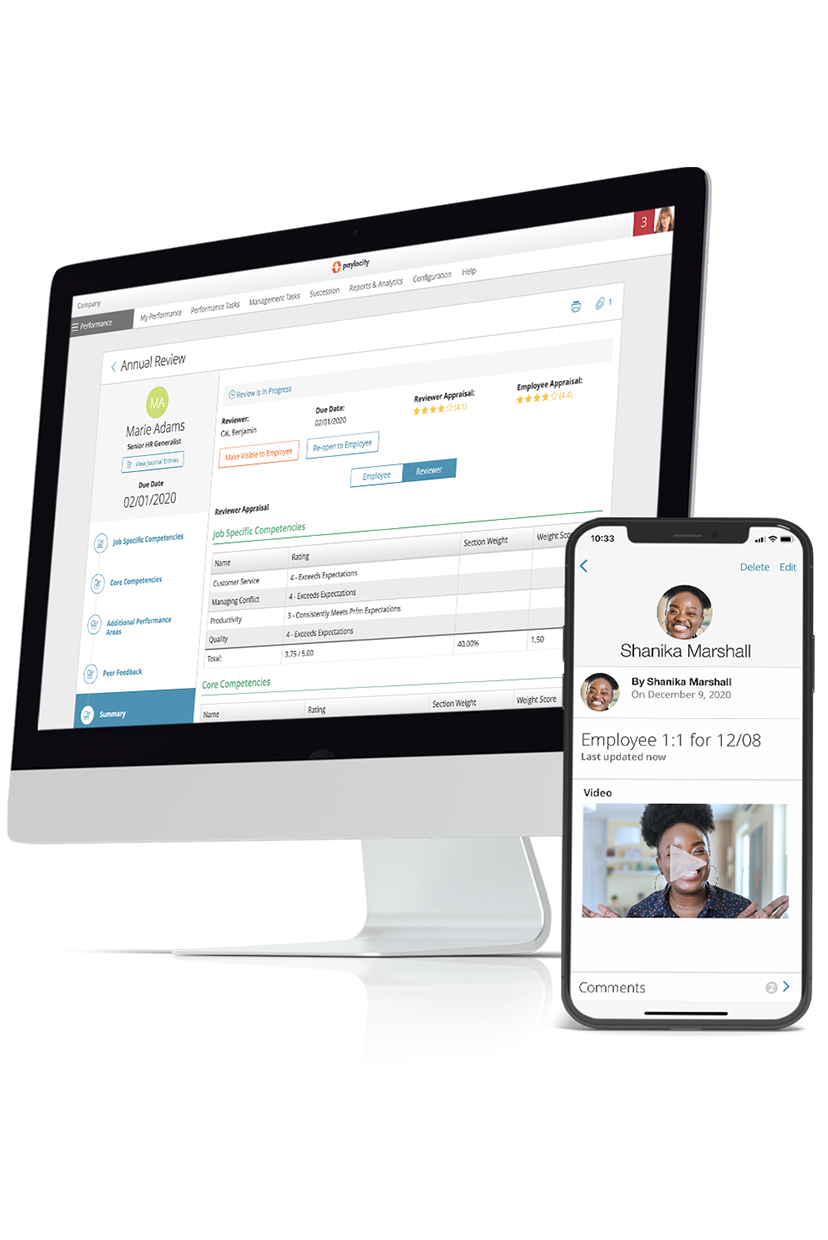
Level up employee performance
Help your employees reach their full potential with modern performance management tools. From goal setting to personalized reviews and ongoing feedback, our solutions enable transparent, two-way communication and encourage employees to take ownership of their growth. Employees expect continuous development and support — give it to them with Performance Management from Paylocity.